CDM INTERNATIONAL, INC.
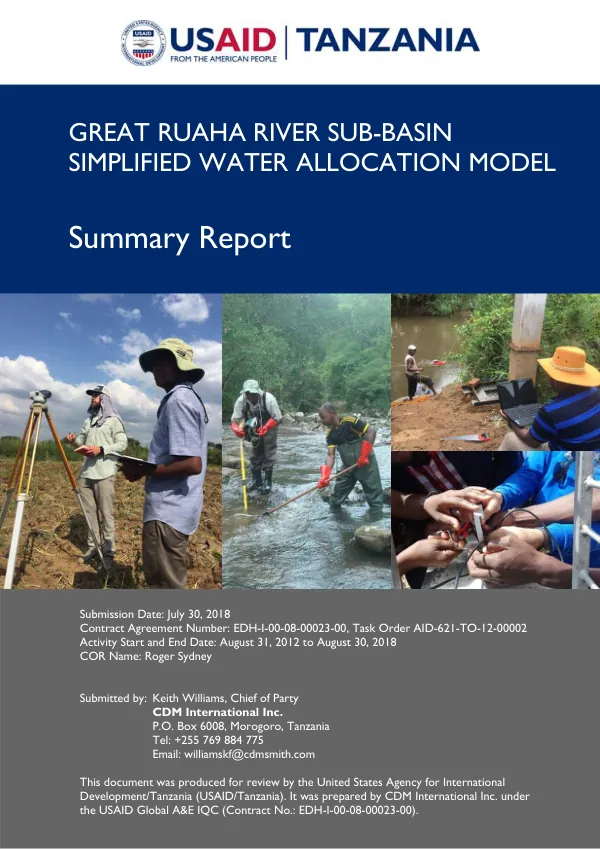
Great Ruaha River Sub-Basin Simplified Water Allocation Model: Summary Report
The Great Ruaha River Sub-Basin Simplified Water Allocation Model (SWAM) framework is a predictive simulation model designed to provide support for decision-making in the areas of water permitting and long-term water planning.
2018 · 88 pages
Sign in to readA free account is required to download.
Abstract
The model was developed in collaboration with the Rufiji Basin Water Board (RBWB) to support implementation of their water permitting program and for carrying out longer term water planning efforts. The model framework represents the Great Ruaha sub-basin river network and its significant water withdrawals, tributaries, and discharges. The guiding principles in determining what elements of the sub-basin to simulate explicitly were to begin with a simple representation, with the focus on the most critical components of the water allocation process. The model is intended to provide predictive simulations of the flow of water in the basin, as well as the allocation of portions of that water to a network of representative water users. The SWAM framework is based on a simplified representation of the Great Ruaha sub-basin, with the focus on the most critical components of the water allocation process. The model includes tributary objects and hydrology, representation of water withdrawals, representation of dischargers, reservoir objects, and groundwater users and associated discharge. The model also includes a detailed representation of the water users and dischargers, including sources of supply, demands, consumptive use, and return flows. The model calibration philosophy and objectives are to provide a robust and reliable model that can be used to support decision-making in the areas of water permitting and long-term water planning. The calibration methods used include a combination of field data collection and model parameter estimation. The results of the model calibration show that the model is able to accurately simulate the flow of water in the Great Ruaha sub-basin and the allocation of portions of that water to a network of representative water users. The Great Ruaha Sub-Basin Model is one of two water allocation simulation models constructed for the Rufiji River Basin. The model is designed to provide support for decision-making in the areas of water permitting and long-term water planning. The model framework represents the Great Ruaha sub-basin river network and its significant water withdrawals, tributaries, and discharges. The model includes a detailed representation of the water users and dischargers, including sources of supply, demands, consumptive use, and return flows. The model calibration results show that the model is able to accurately simulate the flow of water in the Great Ruaha sub-basin and the allocation of portions of that water to a network of representative water users. The model is intended to provide support for decision-making in the areas of water permitting and long-term water planning. The model framework is based on a simplified representation of the Great Ruaha sub-basin, with the focus on the most critical components of the water allocation process. The Great Ruaha Sub-Basin Model is designed to provide support for decision-making in the areas of water permitting and long-term water planning. The model framework represents the Great Ruaha sub-basin river network and its significant water withdrawals, tributaries, and discharges. The model includes a detailed representation of the water users and dischargers, including sources of supply, demands, consumptive use, and return flows. The model calibration results show that the model is able to accurately simulate the flow of water in the Great Ruaha sub-basin and the allocation of portions of that water to a network of representative water users.
Related documents