ACADEMY FOR EDUCATIONAL DEVELOPMENT, INC. (AED)
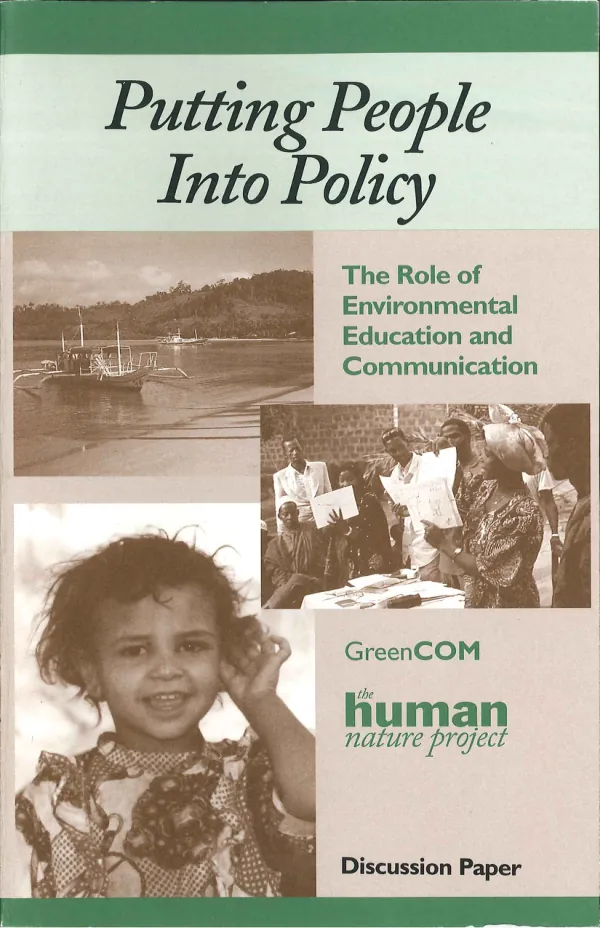
Putting people into policy : the role of environmental education and communication
Environmental education and communication (EE&C) is a vital tool for helping policy makers and stakeholders to integrate their needs, perspectives, and behaviors into the policy development process, as well as for empowering people to voice their environmental needs and concerns.
Scriabine, Raisa · 1996
Sign in to readA free account is required to download.
Abstract
EE&C is defined in this paper as a combination of education, behavioral research, social marketing, gender analysis, participatory methodologies, and communications; its purpose is to change the behaviors of individuals and groups regarding specific environmental issues, while giving them the knowledge and skills to tackle longer-range concerns. The paper provides several examples of EE&C in action. It shows how an innovative EE&C approach promoted environmental awareness across an entire society in The Gambia, how the drafting of Canada"s Green Plan and Environmental Citizenship Principles enabled multiple stakeholders to become involved in shaping environmental policies, and how groups in Costa Rica, Ecuador, and the Philippines used EE&C techniques to promote specific policy changes. In these examples, EE&C provided the communications skills needed to forge and sustain partnerships among often disparate groups, such as NGOs, corporations, and governments. An example from Egypt then shows the importance of behavioral research in the environmental policy arena. Measures of EE&C"s success in improving policy formulation and implementation are discussed in the penultimate section, followed by concluding thoughts about the necessity of adopting a multiple stakeholder process, even it if means a whole new way of doing business, to achieve environmentally sustainable development.