FOOD AND AGRICULTURE ORGANIZATION OF THE UNITED NATIONS IN GEORGIA
Greenhouse Gas Emissions in Bosnia and Herzegovina
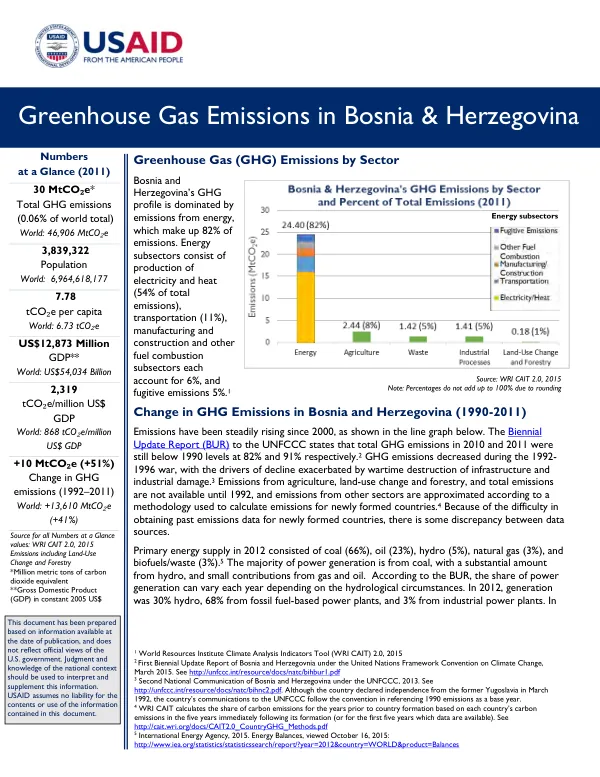
Bosnia and Herzegovina's greenhouse gas (GHG) emissions are primarily driven by energy production, accounting for 82% of total emissions.
2016 · 3 pages
Sign in to readA free account is required to download.
Abstract
The energy sector is comprised of electricity and heat production (54%), transportation (11%), manufacturing and construction, and other fuel combustion subsectors (6% each), and fugitive emissions (5%). The country's GHG emissions have been steadily increasing since 2000, with a 27% increase from 1992 to 2011. In 2010 and 2011, total GHG emissions were 82% and 91% of 1990 levels, respectively. The majority of the country's primary energy supply in 2012 came from coal (66%), followed by oil (23%), hydro (5%), natural gas (3%), and biomass/waste (3%). The majority of power generation is from coal, with a significant contribution from hydroelectric power. The country's energy conversion and industrial fuel combustion subsectors are among the most carbon-intensive, contributing over 80% of total carbon dioxide emissions from energy production in 2010 and 2011. Agriculture emissions in Bosnia and Herzegovina are primarily driven by enteric fermentation (54%), manure management (14%), and manure applied to soils (10%). The agriculture sector is a significant sector for economic development and is related to a substantial share of economic activities, particularly in rural regions. The share of agriculture, forestry, and related services comprised 6.25% of GDP in 2010 and employed 19% of the population. The country's carbon intensity, measured as GHG emissions relative to GDP, has not shown a clear trend over time. The relationship between GHG emissions and GDP is complex, and it is difficult to assess whether the country is becoming more or less carbon-intensive. The country's economic growth has been slower than expected, with the 2012 share of GDP by sector as follows: 6% agriculture, forestry, and fishery; 22% industry and construction; and 56% services. Bosnia and Herzegovina has pledged to reduce its projected emissions by 2% relative to 1990 levels by 2030, through the implementation of various measures, including the construction of co-generation plants, replacement of thermal power plants, and installation of renewable energy sources. The country's National Renewable Energy Action Plan lists the planned installation of renewable energy in the country for the year 2020, including 16.2 MW of solar, 694 MW of hydropower, 350 MW of wind power, and 35.7 MW of biomass.