USAID DEC
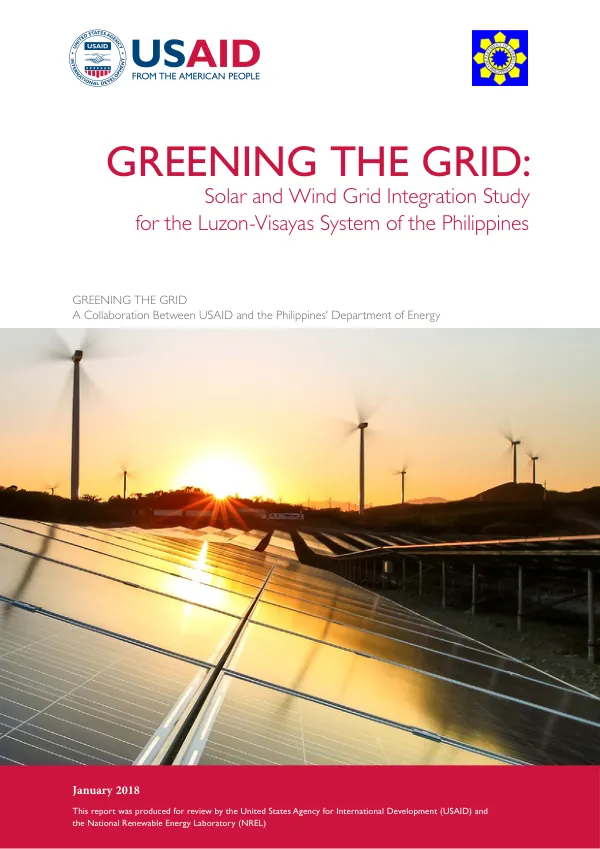
GREENING THE GRID: Solar and Wind Grid Integration Study for the Luzon-Visayas System of the Philippines
Sign inDEUTSCHE GESELLSCHAFT FÜR INTERNATIONALE ZUSAMMENARBEIT GMBH
GREENING THE GRID: Solar and Wind Grid Integration Study for the Luzon-Visayas System of the Philippines
The Philippine power system is characterized by an abundance of renewable energy (RE) resources, including solar and wind energy.
2018 · 113 pages
Sign in to readA free account is required to download.
Abstract
The Department of Energy of the Philippines (DOE) and the United States Agency for International Development (USAID) have spearheaded a study to evaluate the impacts and opportunities associated with achieving high levels of variable RE penetration in the Philippine power system. The study focuses on the integrated Luzon-Visayas grids and aims to characterize the operational impacts of reaching high solar and wind targets. The study highlights the need for an evolution in power system planning and operation due to the variability and uncertainty introduced by solar and wind energy. To address this challenge, the study provides a comprehensive analysis of the operational impacts of high RE penetration on the Philippine power system. The analysis considers various scenarios, including different levels of RE penetration, transmission infrastructure, and demand response. The study identifies several key findings, including the potential for significant reductions in greenhouse gas emissions and improved energy security. However, it also highlights the need for careful planning and management of the power system to ensure reliable and efficient operation. The study recommends the development of a comprehensive grid integration plan, which would involve the coordination of various stakeholders, including the DOE, USAID, and the private sector. The study also emphasizes the importance of data-driven decision-making in the power sector. It highlights the need for accurate and reliable data on RE resources, demand, and transmission infrastructure to support informed decision-making. The study recommends the development of a data management system that would provide real-time data on the power system and enable stakeholders to make data-driven decisions. The study's findings and recommendations are expected to inform the development of the Philippine power sector's long-term plan, which aims to achieve a high level of RE penetration by 2030. The study's results are also expected to contribute to the development of a comprehensive grid integration plan, which would ensure the reliable and efficient operation of the power system. The study was conducted through the active participation of various stakeholders, including the DOE, USAID, and the private sector. The study's results were informed by a comprehensive analysis of various scenarios, including different levels of RE penetration, transmission infrastructure, and demand response. The study's findings and recommendations are expected to have a significant impact on the development of the Philippine power sector and contribute to the achievement of the country's energy security and sustainability goals. The study's methodology involved the use of advanced modeling tools and techniques to simulate the operational impacts of high RE penetration on the Philippine power system. The study's results were validated through the use of real-world data and stakeholder feedback. The study's findings and recommendations are expected to inform the development of the Philippine power sector's long-term plan and contribute to the achievement of the country's energy security and sustainability goals. The study's results highlight the potential for significant reductions in greenhouse gas emissions and improved energy security through the increased use of RE resources. However, the study also emphasizes the need for careful planning and management of the power system to ensure reliable and efficient operation. The study recommends the development of a comprehensive grid integration plan, which would involve the coordination of various stakeholders, including the DOE, USAID, and the private sector. The study's findings and recommendations are expected to have a significant impact on the development of the Philippine power sector and contribute to the achievement of the country's energy security and sustainability goals. The study's results are expected to inform the development of the Philippine power sector's long-term plan and contribute to the achievement of the country's energy security and sustainability goals.
Related documents