CHF
Group Lending Training Report: USAID Tijara Provincial Economic Growth Program
The USAID Tijara Provincial Economic Growth Program is a microfinance initiative implemented by The Louis Berger Group, Inc.
2009 · 6 pages
Sign in to readA free account is required to download.
Abstract
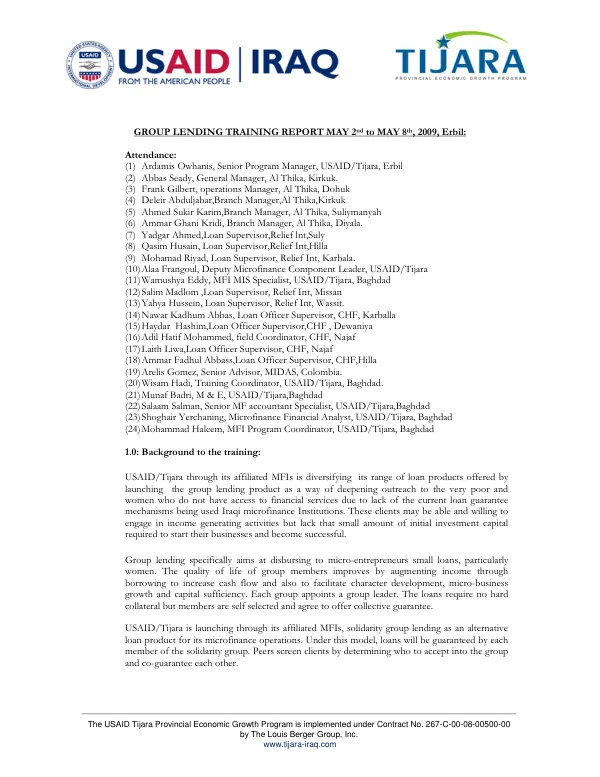
under Contract No. 267-C-00-08-00500-00. The program aims to provide financial services to the poor and women in Iraq through the launch of a group lending product. This product is designed to reach out to the poor segments of the population in the 18 governorates of Iraq. The group lending model enables the efficient delivery of micro-loans to a large number of micro-entrepreneurs who lack access to credit. The program targets the poorest of the poor entrepreneurs as a new market niche. The group lending product is expected to help improve the quality of life of group members by augmenting income through borrowing to increase cash flow and facilitate character development, micro-business growth, and capital sufficiency. The objectives of the training program, which took place from May 2nd to May 8th, 2009, in Erbil, were to introduce participants to basic group lending skills and build the requisite institutional capacity to handle group loans as a core product of the MFI loan portfolio. The training aimed to strengthen staff capacity in the execution of their daily loan activities, adopt innovative and cost-effective procedures, introduce participants to models of microfinance best practices related to group lending, and develop an action plan for the three big MFIs to start disbursing group loans to clients by the end of May 2009. The training program was participant-centered and highly interactive, involving a combination of facilitator presentations, group work sessions, and participant presentations. The training materials used included presentation slides and a training schedule detailing the course content on group lending. The program was facilitated by Arelis Gomez, the USAID/Tijara Consultant and lead training resource person. The participants indicated that the training program and topics covered were very useful and relevant to their work. They acquired new skills, which will help them correct mistakes in their current loan tracking procedures for both individual and group loans. The participants also learned how to design and deliver group loans to their clients and develop internal group loan tracking systems for their institutions. The assessment of the Consultant's competencies found gaps in the way the training materials were prepared and presented. However, the Consultant was able to develop adequate generic samples of the relevant study materials, which were distributed to participants for use and further reference on the subject. The Consultant has a good understanding of the subject and was able to successfully deliver on the subject, covering all the topics listed on the training schedule and explaining the subject in detail to the participants. The training program helped to increase the participants' understanding of different group loan tracking systems, reporting, and internal risk mitigation mechanisms. It also helped the participants to appreciate group lending as a viable loan delivery channel that can help institutions reach out to the poor segments of the population.
Related documents