USAID. BUR. FOR HUMANITARIAN RESPONSE. OFC. OF TRANSITION INITIATIVES
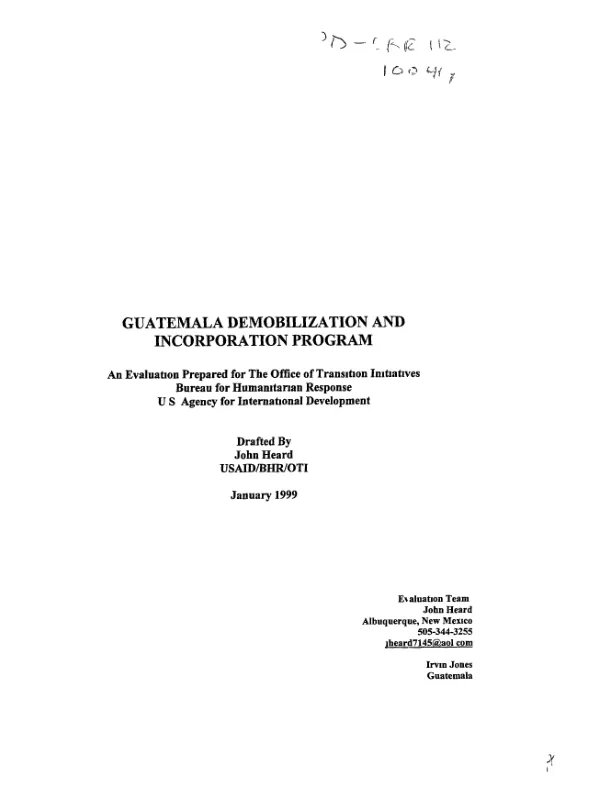
Guatemala demobilization and incorporation program : an evaluation
Final evaluation of a project (11/96-12/98) to promote the demobilization and economic and social reintegration of guerilla forces in Guatemala.
Heard, John|Jones, Irvin · 1998
Sign in to readA free account is required to download.
Abstract
The project was implemented by the International Office of Migration (IOM) under the aegis of USAID's Office of Transition Initiatives (USAID/OTI) and the U.N. Development Program (UNDP). Overall, the program was a success. Ex-combatants have been effectively demobilized and resettled in viable or potentially viable settings and have been accepted by surrounding communities. Stability has been established throughout the countryside, the emergency is over, and conditions for truly sustainable development are in place, given adequate follow-through by the Government of Guatemala (GOG) and the donor community on the reform plan established by the Peace Accords. In the emergency phase (1-5/97), the project built 26,000 sq m of quality living and working space in 8 demobilization camps capable of housing over 3,000 combatants, demobilized and documented 2,940 guerrillas in the camps over a 2-month period, and provided them training through a highly efficient team effort by the international community. In the initial incorporation phase (5/97-11/98), the project: resettled former combatants from the camps to final destinations throughout the country, including 323 people "without destination" who were placed in halfway hostels prepared for this purpose; provided technical vocational training to 1,148 ex-combatants; placed and gave initial assistance to 277 ex-combatants on cooperative farms purchased by the GOG; provided productive enterprise assistance to 419 ex-combatants through 220 individual projects; provided literacy and basic education training to 3,338 beneficiaries (including a community civilian participation of close to 40%); conducted, for a cross-section of 1,375 participants from the demobilized and community-based sectors, a country-wide social communication campaign that explained the Peace Accords and the rights of returning ex-combatants and facilitated reconciliation; provided essential assistance in the return and incorporation of 151 families (493 persons) of Unidada Revolucionaria Nacional Guatemalteco (URNG) supporters from Mexico and other countries; provided 953 demobilized military police with technical vocational training, tool kits, and apprenticeships with local companies, directly resulting in the employment of 126 military ex-combatants; helped relocate and resettle one "Community of Populations in Resistance" in the mountains of Quiche to a cooperative farm, involving 250 families with 890 individuals; and provided critically needed infrastructure and medical supplies to two other communities. USAID/OTI and its funding partner, UNDP, were recognized as the two most important donor contributors to the transition process by all major stakeholders, including the URNG, the GOG, the United Nations, and the donor community in general. Further, USAID/OTI, together with UNDP and IOM, exhibited outstanding leadership, commitment, and good sense throughout the project in the face of exceedingly severe political, logistical, and other constraints. The fact that USAID/OTI entered at the beginning and left at the end of the transitional effort, having successfully completed its mission, is an exceedingly rare and important accomplishment and should serve as a model for future programs. The most important factor in the project's success was its personnel: the project was blessed with a unique confluence of exceptional leadership on both the donor and Guatemalan sides. Other success factors included donor and GOG flexibility, the coordinating role of the Special Incorporation Commission, the positive relationship with the URNG, and the relatively small size (3,000) of the force to be demobilized. Constraints included lack of planning, the political nature and technical shortfalls of the Fundacion Guillermo Toriello, the absence of a role for the private sector, and a severe lack of information management. More specific lessons are include in the report.
Related documents