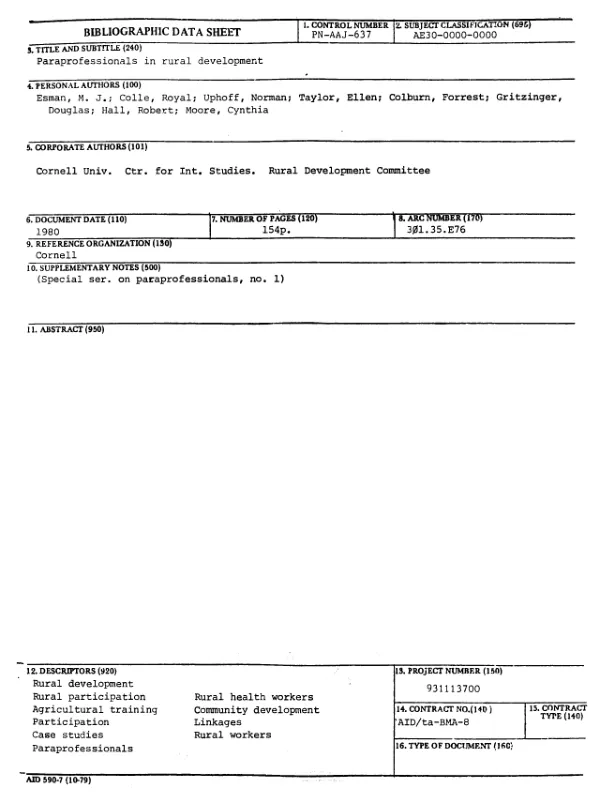
CORNELL UNIVERSITY. CENTER FOR INTERNATIONAL STUDIES
GUATEMALA"S RURAL HEALTH PARAPROFESSIONALS
To redress the frequent bias of developing country health care systems toward providing high-cost, professional, curative care in urban areas to the neglect of delivering basic health care services in isolated rural areas, paraprofessional health workers are being increasingly used to serve the rural poor.
Colburn, Forrest D. · 1970
Sign in to readA free account is required to download.
Abstract
This field study, one of six conducted by Cornell University, reviews the effectiveness of paraprofessionals in rural Guatemala. The origin and development of Guatemala"s health paraprofessional program and its implementation in eight villages are reviewed. Despite stiff (and continuing) opposition from the physician-dominated health care community, the Guatemalan Ministry of Public Health and Social Assistance (MOPHSA) created two new layers of auxiliary health personnel to serve the rural poor -- village health promoters and Rural Health Technicians (RHT). Promoters are village volunteers who receive one month of non-technical training, mainly in preventive health care. RHT"s are full-time MOPHSA outreach workers who receive 2 years of technical training. Obstacles faced by paraprofessionals in their work included rampant poverty, fatalistic attitudes, and disrespect by villagers. Promoters in particular suffered from scarce resources and a lack of supervision by RHT"s. Political fears of promoting community organizations or of being called "communists", as happened to at least one health promoter, also hamper promoter effectiveness. Approximately half of the promoters no longer practice due to lack of compensation or encouragement. The evidence suggests, nevertheless, that the paraprofessional program has brought health care to previously deprived areas (although evidence of illness or death declines is lacking) and that health promoters in particular have promoted community organization and are now providing limited curative care. In conclusion, the author discusses three ways to improve program effectiveness: increasing the resources available to promoters and their supervision by RHT"s and improving cooperation between employees -- paid or not -- of concerned Guatemalan ministries. A 10-item bibliography (1974-79) in English and Spanish and a health promoter"s newsletter in Spanish are appended.