CORNELL UNIVERSITY. CENTER FOR INTERNATIONAL STUDIES
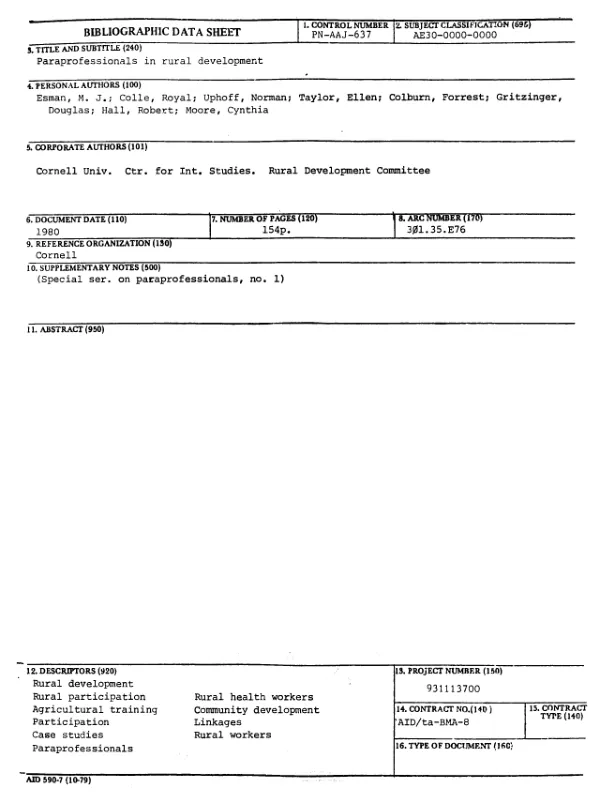
PARAPROFESSIONALS IN RURAL DEVELOPMENT
The reluctance of developing country professionals to work in remote rural areas and the prohibitive cost of delivering the social services so sorely needed there attests to the need for effective paraprofessionals (PP"s) as agents of rural development.
ESMAN, MILTON J.; COLLE, ROYAL D. · 1970
Sign in to readA free account is required to download.
Abstract
This report, based upon a study of PP programs in six nations, describes the role of PP"s in rural development, as well as the factors which spell success or failure for development efforts employing such personnel. The PP is active mainly in health or agricultural roles and performs a wide variety of tasks, from delivering services or information to serving as community organizer. Sponsors of development programs, however, often undermine their efforts by wrongly assuming that volunteer or underpaid PP"s will perform efficiently ad infinitum, with community support assured and without adequate supplies or inspection. Three factors are thus crucial to PP: (1) an adequate program design; (2) an appropriate support system; and (3) strong community participation. PP program design must base the PP"s duties, selection, and compensation upon the targeted area"s needs and social context. Moreover, PP tasks and accountability must be well defined. Insufficient supervision and support are usually the major flaws of PP programs. Adequate supervision ensures the PP"s discipline, local prestige, continued training, and increased morale. Inadequate support in terms of supplies and equipment often separates programs that are only initially successful from those that are continually viable. To ensure the program"s continuity, community participation must be included in it from beginning to end, especially regarding PP selection and support for and evaluation of the program. Donor agencies should promote PP activities in the areas cited above. Appended to the report are an assessment of PP agricultural roles; a 132-item bibliography (1902-80); and summaries of case studies in Bolivia, Guatemala, Senegal, Sri Lanka, Upper Volta, and the Philippines.