USAID. MISSION TO GUINEA
Guinea education sector reform : Guinea education sector support
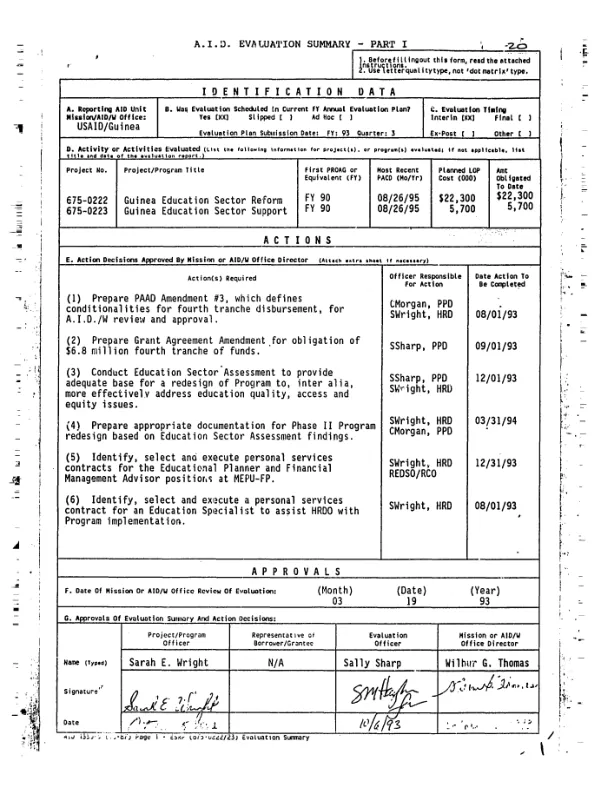
Summarizes midterm evaluation (XD-ABF-894-A) of a program/project to support education reform under Guinea"s Programme d"Adjustement Sectoriel d"Education (PASE).
1993
Sign in to readA free account is required to download.
Abstract
The evaluation covered the period 10/90-4/93. Assistance by USAID and other donors to the PASE has contributed to a sense of commitment and enthusiasm for educational reform, the environment for which has never been better. The Ministry of Education"s (MEPU) budget is now the most detailed and rationalized of all Ministry budgets and has increased significantly as a percentage of the national budget. An expenditure tracking system has been developed; however, significant problems remain in the management and execution of the budget. In other gains, village communities are participating in school construction, maintenance, and teacher monitoring; the project has set up a data collection and school mapping system to locate classroom building and renovation needs and to set priorities for assistance; and it has supported the deployment of 1,435 administrators and secondary school teachers to meet staffing needs in primary schools. The PASE has identified the need for strong central institutions capable of controlling and distributing increasing resource flows to schools nationwide. However, an even broader base of support is both desirable and possible. While these gains are crucial, critical weaknesses remain. MEPU is unable to meet the growing demand for access to primary education which the PASE has created. Greater emphasis on qualitative rather than quantitative improvement (e.g., lowering student-teacher ratios) is recommended, along with increased reliance on the private sector and local participation. In addition, little progress has been made in the area of equitable access to education for rural children and, especially, girls. The PAAD included no explicit procedures for achieving equity goals. Timely delivery of high-quality TA has been impeded by a number of difficulties. The project got off to a slow start, and Florida State University (FSU), the contractor, had problems recruiting French-speaking experts in French systems of accounting. USAID/G experienced a turnover in personnel, a problem exacerbated by a trend in A.I.D./W that de-emphasized staffing for technical positions in education, making it difficult to finding a replacement for the departing Mission education officer. Many of the deliverables requested of FSU were not produced, some were delivered late, and the quality of many is questionable. One of the more serious management deficiencies was the lack of an overall programmatic or budget strategy prepared by either USAID or FSU. In addition, training of MEPU personnel has fallen behind, and the buy-in to IEES, an A.I.D./W education project, has not met expectations. While the program"s conditionalities are similar to those of the World Bank"s program for the PASE, the two programs have differing documentation and reporting requirements. This overlap causes confusion regarding Government of Guinea (GOG) compliance with program conditionality and increases USAID"s management burden. Also, it is recommended that the program grant should no longer be linked to debt repayment; rather, it should be earmarked only for primary education purposes. The following lessons learned were learned. (1) A.I.D. should reserve its assistance for sectors in which it has special capability and comparative advantage. (2) A.I.D./W should be more responsive to Mission requests for assistance, especially when local conditions are difficult. (3) The United States should maintain high standards of performance for development projects and refuse to be co-opted by local approaches in the name of cultural sensitivity. Similarly, cooperation with other donors should not prevent A.I.D. from exercising its own best judgment. (4) A.I.D./W, though responsible for determining broad guidelines for implementing the Foreign Assistance Act, must adapt these guidelines to local conditions. In Guinea, for example, project rather than nonproject assistance may be more suitable at present.
Related documents