USAID. BUR. FOR POLICY AND PROGRAM COORDINATION. CENTER FOR DEVELOPMENT INFORMATION AND EVALUATION (CDIE)
Promoting primary education for girls in Guinea
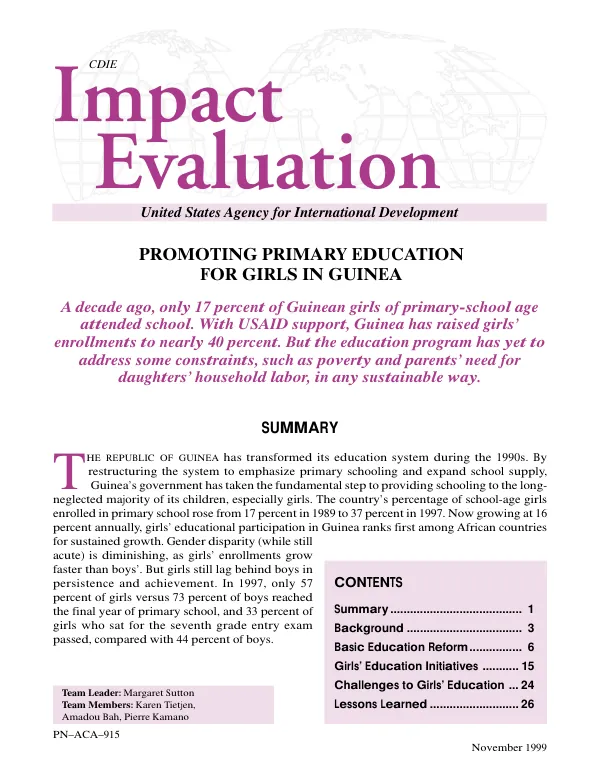
During the 1990s, the Republic of Guinea restructured its education system to increase primary school access for the long-neglected majority of its children, especially girls.
Sutton, Margaret|Tietjen, Karen · 1999
Sign in to readA free account is required to download.
Abstract
As a result, the percentage of girls enrolled in primary school rose from 17% in 1989 to 37% in 1997. Now growing at 16% annually, girls' educational participation in Guinea ranks first among African countries for sustained growth. Gender disparity, while still acute, is diminishing, as girls' enrollment grows faster than does boys'. But girls still lag behind boys in persistence and achievement. In 1997, only 57% of girls vs. 73% of boys reached the final year of primary school, and only 33% of girls passed the seventh grade entry exam, vs. 44% of boys. Guinea's reform program has also resuscitated demand for schooling in a country where enrollments had been declining. Notably, this demand includes schooling for girls, owing in large part to activity spurred by the former education minister and an awareness campaign carried out by the Ministry of Pre-University Education (MEPU). Highly visible policy and institutional changes (such as latrines, female teachers, and a liberalized pregnancy policy) have signaled parents that their daughters are welcome in school. They also have reduced some obstacles to girls' educational participation. The Equity Committee established by MEPU to launch its education initiative for girls has increased awareness of girls' participation, though its efforts have remained outside the mainstream of MEPU operations. USAID has played a leading role in supporting these changes. Through its Education Sector Reform program (6750222/6750223), the Fundamental Quality and Equity Levels project (6750230), and the centrally-funded Girls and Women's Education project (9365848), the Agency provided budgetary and technical support in areas essential to reforming the education system: policy, financial management, and planning and information systems development. It introduced girls' education to the Guinean government's agenda, as well as to other donors' agendas, creating a climate of support for girls' education through careful use of performance conditions, technical assistance, and project support for training and non-routine activities, such as research and the awareness campaign. USAID helped MEPU build the head of steam needed to drive its reform efforts. The Guinean government now faces three major challenges to advancing girls' education: (1) responding to the demand created by the awareness campaign; (2) coordinating the donors who wish to participate in Guinea's successful reform effort; and (3) integrating the needs of girls and other vulnerable groups into mainstream educational services instead of supporting special projects. The government also must concentrate more on school quality to improve efficiency and sustainability. Guinea's experience demonstrates that a unified message delivered through activist national leadership, media, and local leadership -- made concrete in new schools with visible policy changes -- can go far in setting the stage for increasing girls' education. Basic education reform, coupled with girl-specific policies and programs, are powerful and effective tools for improving girls' participation. Other lessons learned include the following: (1) Baseline assessment and analysis are requirements for gender-aware policy and program design. (2) A coherent education policy and investment framework must be applied to girls' education initiatives. (3) The most important changes regarding gender roles take place on the local level. (4) A mix of conditionality and projectized support was effective in putting girls' education on the agenda. (5) Sustained, integrated support is necessary to consolidate MEPU's early efforts in girls' education. (6) Efforts to improve quality and enhance equity must proceed in tandem. (Author abstract, modified)
Related documents