ICF
Haiti Baseline Survey
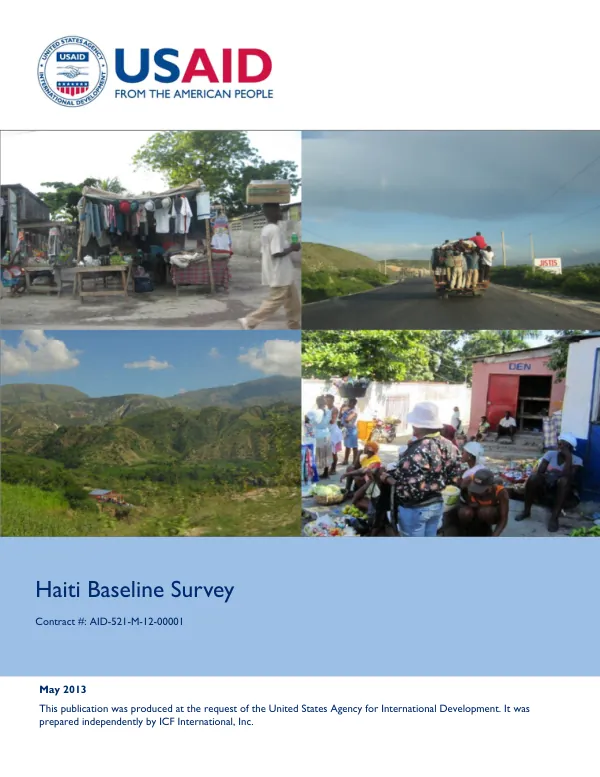
The Haiti Baseline Survey was conducted in May 2013 to assess the country's social, economic, and health indicators.
2013 · 94 pages
Sign in to readA free account is required to download.
Abstract
The survey aimed to provide a comprehensive understanding of the Haitian population's needs and challenges. The study design involved a stratified sampling method, with a sample size of 4,500 households. The survey collected data on various aspects, including household population, shelter and infrastructure, public services and governance, health, fertility, maternal and newborn health, child health, nutrition, child literacy, household hunger, and agricultural production. Household population data revealed that the majority of households consisted of 4-6 members, with a median age of 25 years. The most common occupations were farming, trading, and services. Shelter and infrastructure conditions were found to be inadequate, with 70% of households lacking access to improved sanitation facilities. Household consumption patterns indicated that the majority of households relied on subsistence farming and informal markets for their livelihoods. Public services and governance indicators showed that the delivery of essential services such as healthcare, education, and water was inadequate. Governance was also found to be weak, with limited participation of citizens in decision-making processes. Health indicators revealed that 40% of the population lacked access to healthcare services, and 60% of women reported experiencing difficulties in accessing healthcare. Fertility rates were high, with an average of 4.5 children per woman. Maternal and newborn health indicators showed that antenatal care coverage was low, with only 30% of pregnant women receiving care. Delivery care was also inadequate, with 50% of births occurring at home without medical assistance. Child health indicators revealed that infant and child mortality rates were high, with 60 deaths per 1,000 live births. Vaccination coverage was low, with only 50% of children receiving all recommended vaccinations. Nutrition indicators showed that 40% of children under the age of 5 suffered from stunting, and 20% suffered from wasting. Breastfeeding rates were low, with only 30% of mothers exclusively breastfeeding their infants. Infant and young child feeding practices were also found to be inadequate, with 50% of children receiving solid foods before the age of 6 months. Agricultural production indicators revealed that the majority of households engaged in subsistence farming, with 70% of households cultivating seasonal crops. The most common crops cultivated were maize, beans, and sweet potatoes. However, agricultural production was hampered by inadequate access to inputs, with 60% of households lacking access to fertilizers and 50% lacking access to irrigation systems. Women's empowerment in agriculture was found to be limited, with 70% of women reporting that they had no control over agricultural decisions. The survey also highlighted the need for improved agricultural extension services, with 60% of households reporting that they had not received any agricultural advice in the past year. Overall, the survey provided a comprehensive understanding of the Haitian population's needs and challenges, highlighting the need for improved access to healthcare, education, and agricultural services.