ABT. GLOBAL
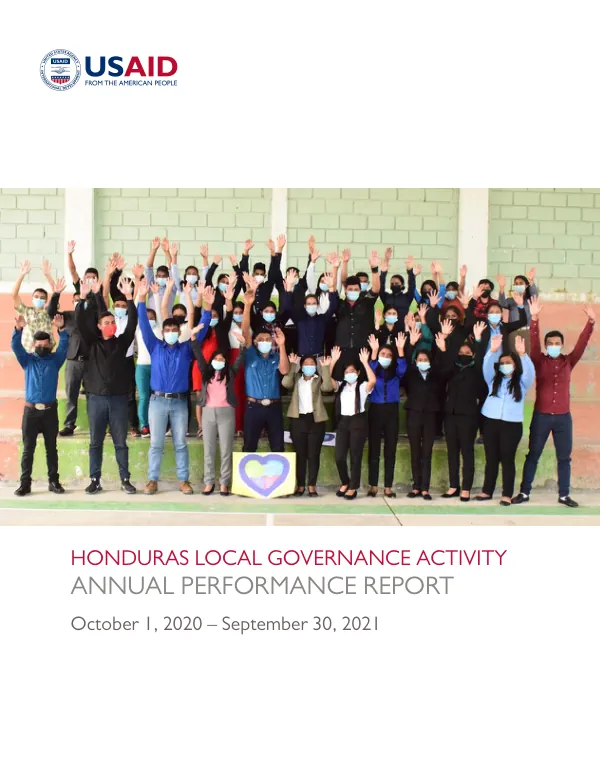
Annual Performance Report FY 2021
The Honduras Local Governance Activity works to enhance basic service delivery provision through increased citizen influence and improved governance in Honduras.
2021 · 30 pages
Sign in to readA free account is required to download.
Abstract
To strengthen basic services where the majority of Honduran citizens interact with their government, the Activity works to strengthen governance actions at the national, subnational, and local level. In the most vulnerable departments of Western Honduras, the Activity works to ensure that USAID investments in nutrition, health, water and sanitation, education, and other critical services are expanded, and made sustainable to reduce extreme poverty. The Activity also contributes to citizen security and access to health services for vulnerable populations in high-crime Urban Areas through capacity development of local government and health service providers to respond to the COVID-19 pandemic. The Activity works to strengthen the essential capacity of civil society groups, local governments, and service providers to provide citizens with improved services. In alignment with USAID Honduras' Country Development Cooperation Strategy (CDCS) for 2020-2025 and its goal of "a more prosperous, democratic and secure Honduras where citizens, especially youth, are inspired to stay and invest in their future," the Activity further expanded its efforts to reduce irregular migration, reintegrate migrant returnees, and adopt Positive Youth Development (PYD) approaches. During its second quarter, the Activity expanded its work to Urban Areas in Honduras and began working directly with the health sector to mitigate the effects of the COVID-19 pandemic. The Activity reversed the scheduled departure of its technical team, created a new organizational structure, opened two new regional offices in La Ceiba and San Pedro Sula to create a physical presence throughout its zones of influence, and recruited new staff to meet its workplan and operational objectives. The Activity also assisted recovery efforts in Western Honduras after the back-to-back hurricanes of Eta and Iota in November 2020 that ravished the livelihoods of vulnerable rural populations, which already suffered from food insecurity and high levels of violence. The Activity achieved several key results during the reporting period. Citizen participation in service delivery decision-making was strengthened through the implementation of citizen engagement mechanisms, such as citizen councils and participatory budgeting processes. Evidence-based citizen oversight of service delivery was increased through the establishment of citizen monitoring committees and the provision of training on data analysis and reporting. Local service provider performance was improved through the implementation of accountability mechanisms, such as performance-based contracts and citizen feedback systems. Service providers' capacity to manage service delivery was improved through the provision of training on service management and the establishment of service delivery units. Local government administrative management capacity was increased through the provision of training on financial management and the establishment of local government transparency and accountability mechanisms. The Activity also made significant progress in reducing irregular migration, reintegrating migrant returnees, and adopting Positive Youth Development (PYD) approaches. The Activity worked with local governments and civil society organizations to develop and implement programs aimed at reducing irregular migration and promoting the reintegration of migrant returnees. The Activity also provided training and technical assistance to local governments and civil society organizations on PYD approaches, which aim to promote the social, emotional, and economic well-being of youth. The Activity's efforts to reduce irregular migration and promote the reintegration of migrant returnees were supported by the establishment of a migrant returnee reintegration program, which provided assistance to migrant returnees in the form of cash transfers, vocational training, and access to education and healthcare. The Activity also worked with local governments and civil society organizations to develop and implement programs aimed at promoting the social, emotional, and economic well-being of youth, including programs focused on education, employment, and community engagement. The Activity's work in reducing irregular migration and promoting the reintegration of migrant returnees was also supported by the establishment of a migrant returnee reintegration fund, which provided financial assistance to migrant returnees to support their reintegration into their communities. The Activity also worked with local governments and civil society organizations to develop and implement programs aimed at promoting the social, emotional, and economic well-being of youth, including programs focused on education, employment, and community engagement. The Activity's efforts to reduce irregular migration and promote the reintegration of migrant returnees were also supported by the establishment of a migrant returnee reintegration information system, which provided data and analysis on migrant returnee reintegration efforts and helped to identify areas for improvement. The Activity also worked with local governments and civil society organizations to develop and implement programs aimed at promoting the social, emotional, and economic well-being of youth, including programs focused on education, employment, and community engagement. The Activity's work in reducing irregular migration and promoting the reintegration of migrant returnees was also supported by the establishment of a migrant returnee reintegration coordination mechanism, which brought together local governments, civil society organizations, and other stakeholders to coordinate reintegration efforts and share best practices. The Activity also worked with local governments and civil society organizations to develop and implement programs aimed at promoting the social, emotional, and economic well-being of youth, including programs focused on education, employment, and community engagement. The Activity's efforts to reduce irregular migration and promote the reintegration of migrant returnees were also supported