USAID DEC
Health care financing in Latin America and the Caribbean, 1985-89 : findings and recommendations
Sign inGROUP HEALTH ASSOCIATION OF AMERICA
Health care financing in Latin America and the Caribbean, 1985-89 : findings and recommendations
As the result of economic crises, public health care expenditures and quality have declined in most Latin American countries.
Gwynne, Gretchen|Zschock, Dieter K. · 1989
Sign in to readA free account is required to download.
Abstract
This report presents findings on health care financing in ten countries -- Belize, Bolivia, the Dominican Republic, El Salvador, Ecuador, Guatemala, Peru, St. Lucia, Jamaica, and Honduras. Background information on the countries' economies, health systems, and donor health policies is followed by research findings on three topics: health care costs, household demand for health care, and the feasibility of alternatives to financing health care from general tax revenues (e.g., social security programs, private prepaid risk-sharing plans, and user fees). The report recommends that donors continue to emphasize public health care, but broaden their scope to include assistance to medical care programs under social security. These two subsectors account for two-thirds or more of total health sector financing in the countries reviewed, and they have the main responsibility for serving the low- and middle-income population. Cost containment efforts should target large hospitals operated by ministries of health and social security institutions and focus on limiting personnel budgets and redirecting ambulatory care from hospitals to primary health care facilities.
Connected topics
Related documents
Documents in this collection
 1988
1988USAID DEC
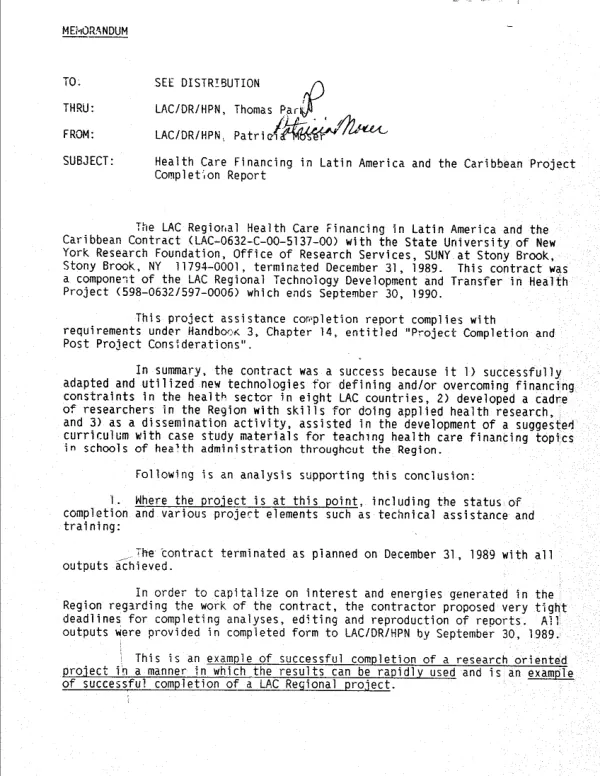
Mid-term external evaluation of technology development and transfer in health project, component for health care financing (State University of New York at Stony Brook)
Open record 1990
1990USAID DEC
![[Synergy project] Latin America and Caribbean Regional HIV/AIDS initiative (LACRI) : [final] annual report FY2002](https://covers.devme.ai/gen/58132.webp)
![LAC regional -- health priorities [project] (598-0825) : maternal mortality initiative](https://covers.devme.ai/gen/65722.webp)