USAID DEC
Evidence review: The effect of education programs on violence, crime, and related outcomes
Sign inUSAID DEC
Evidence review: The effect of education programs on violence, crime, and related outcomes
The education system plays a crucial role in preventing and mitigating violence and crime in the Latin America and the Caribbean region.
2021 · 20 pages
Sign in to readA free account is required to download.
Abstract
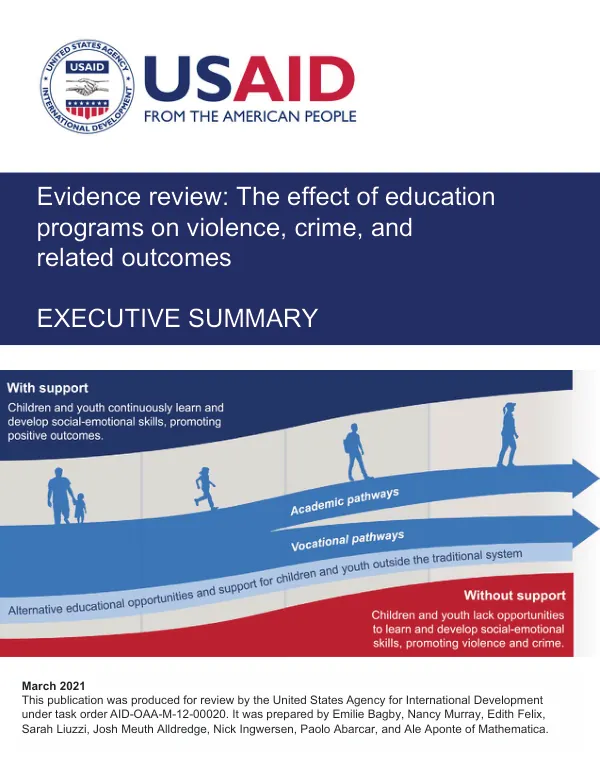
The conceptual framework, or theory of change, suggests that children and youth are most likely to avoid violence and crime if they remain safely engaged in school and continue their learning, while developing the social-emotional skills that will help them to avoid involvement in risky behaviors, violence, and crime. Key outcomes correlated with violence and crime include school engagement, educational attainment, learning, employment, and earnings. Cognitive skills can reduce one's likelihood of engaging in violence and crime by improving educational attainment, learning, and/or employment and earnings outcomes. Social-emotional skills can affect the likelihood of engaging in violent and criminal behaviors by strengthening one's ability to control their behavior, enable them to plan ahead to avoid criminal activity, or help them to think through problems in ways that lead to solutions that avoid violence. Environmental factors, such as the home environment, school environment, and community environment, can contribute to child or youth social-emotional skill development and behaviors, which can contribute to violence and crime through various pathways. Risky, aggressive, and antisocial behaviors can increase the incidence of violent and criminal behavior. Protective behaviors can decrease engagement in violent and criminal behaviors, either directly or indirectly through reductions in risky behaviors that may reduce engagement in violent and criminal behaviors. The purpose of this review was to identify the global literature on the role of education programming in mitigating violence and crime, with a focus on identifying studies that were relevant to and conducted in the LAC region. The review focused on the outcomes that are not typically included in education studies, such as social-emotional skills, environmental factors, and risky and protective behaviors. A comprehensive bibliographic and grey literature search was conducted, and 475 studies across different education programs were reviewed using a common protocol. The review highlights the importance of education programming in mitigating violence and crime, particularly in the LAC region. However, it also highlights key gaps in the evidence base, including the scant evidence available on the topic, particularly from LMICs and LAC. The review serves to highlight the need for further research to address these gaps and to inform education programming decisions. The education system can help children and youth lead productive lives and prevent divergence onto negative pathways where violence and crime play a part. The conceptual framework suggests that children and youth are most likely to avoid violence and crime if they remain safely engaged in school and continue their learning, while developing the social-emotional skills that will help them to avoid involvement in risky behaviors, violence, and crime.
Related documents