USAID. BUR. FOR PROGRAM AND POLICY COORDINATION. CENTER FOR DEVELOPMENT INFORMATION AND EVALUATION (CDIE)
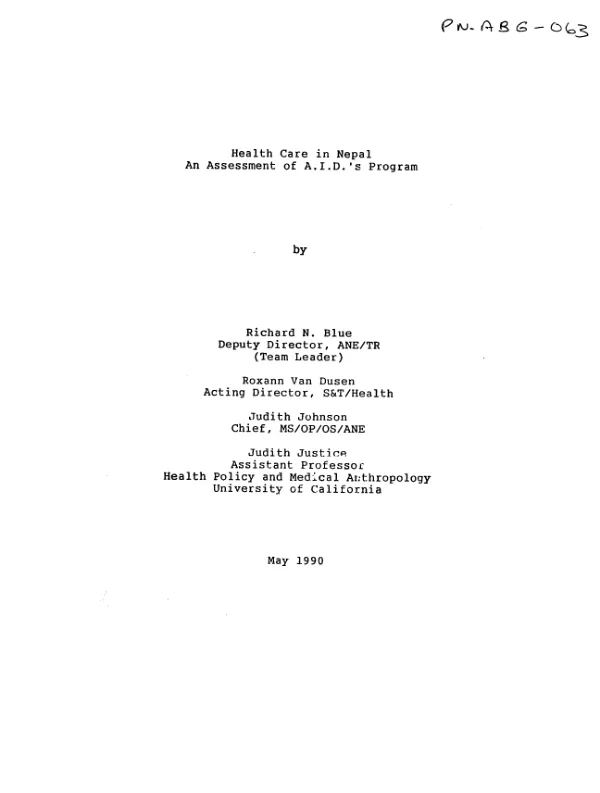
Health care in Nepal : an assessment of AID"s program
The evolution of Nepal"s health care system and the impact thereon of A.I.D.
Blue, Richard N.; Van Dusen, Roxann · 1991
Sign in to readA free account is required to download.
Abstract
programs over the past 30 years are assessed. Major findings are as follows. (1) Health status has improved, as reflected by increasing life expectancy, declining infant mortality, and substantial control and reduction of malaria. A.I.D. programs -- especially malaria and diarrheal disease control, technical and managerial training of health workers, and (with UNICEF) the Expanded Program of Immunization -- have contributed notably to these improvements. (2) The family planning program, which until recently focused overly on sterilization and did not offer a broad choice of methods, has not been a success; only 15% of Nepalese practice modern contraception. (3) Persistence of high female morbidity, maternal mortality, neonatal disorders, and high incidence of diarrhea, worms, respiratory infections, and skin diseases suggests a cluster of maternal/child health problems which do not respond well to either vertical campaigns or passive curative treatment. These problems may be associated with low levels of female education and poverty, including extremely poor hygiene and polluted water supply. (4) The system has been dominated by the Government of Nepal"s (GON) effort to fulfill its promise to provide a reasonable level of health care to all citizens. While the gains from this approach are undeniable, many institutional weaknesses persist. Most importantly, the demand for health care outstrips the GON"s ability -- especially financial -- to meet it. (5) The private sector"s role in health care is poorly defined, despite widespread willingness to use private, fee-for-service sources. Efforts of nongovernmental organizations (NGO"s) to implement health insurance or prepaid drug schemes, and NGO experience in general, are largely ignored by the GON. (6) GON efforts to decentralize health care decisionmaking have thus far consisted of little more than formal changes in the organizational chart. The recent establishment of a corps of women community health volunteers is a positive sign, though there is a danger that this corps will be incorporated into the system as a new "bottom rung" of the health bureaucracy. (7) The advent of a new, potentially democratic government gives Nepal a chance to reexamine its approach to health care and A.I.D. a unique opportunity to help chart a fresh approach. (Author abstract, modified)