MEASURE EVALUATION PRH
Health Information System Performance Monitoring Tool (HISPMT)
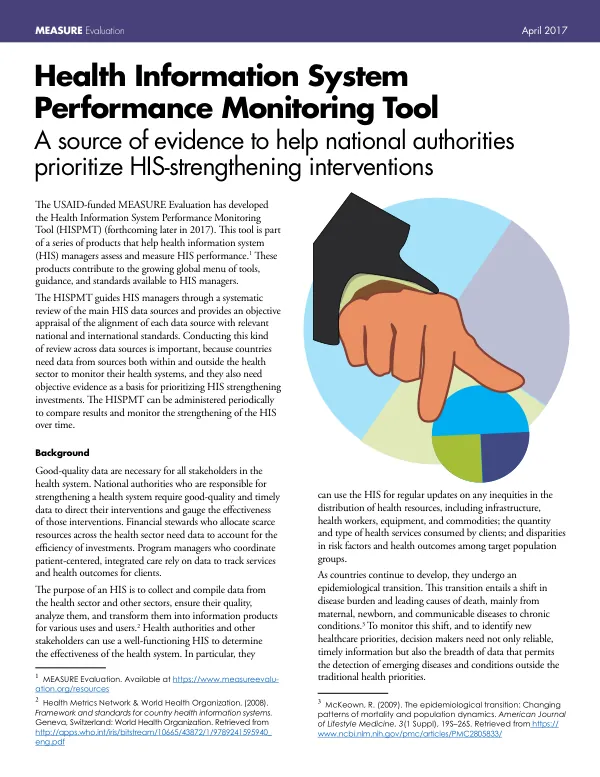
The Health Information System Performance Monitoring Tool (HISPMT) is a source of evidence to help national authorities prioritize HIS-strengthening interventions.
2017 · 3 pages
Sign in to readA free account is required to download.
Abstract
Developed by MEASURE Evaluation, the tool guides HIS managers through a systematic review of the main HIS data sources and provides an objective appraisal of the alignment of each data source with relevant national and international standards. Good-quality data are necessary for all stakeholders in the health system, including national authorities, financial stewards, and program managers. The purpose of an HIS is to collect and compile data from the health sector and other sectors, ensure their quality, analyze them, and transform them into information products for various uses and users. Health authorities and other stakeholders can use a well-functioning HIS to determine the effectiveness of the health system. As countries continue to develop, they undergo an epidemiological transition, shifting from maternal, newborn, and communicable diseases to chronic conditions. To monitor this shift and identify new healthcare priorities, decision makers need reliable, timely information and a breadth of data that permits the detection of emerging diseases and conditions outside the traditional health priorities. However, many countries do not have a sufficiently well-functioning HIS to generate the quality and range of data to produce needed information. The HISPMT is designed to produce objective measures of HIS performance across the main HIS data sources and provide summary evidence to decision makers that they can use to monitor the performance of the national HIS and prioritize HIS-strengthening investments. The tool consists of a suite of automated Microsoft Excel worksheets and can be downloaded from the MEASURE Evaluation website. The HISPMT is grounded in data source standards that are relevant to any country, but MEASURE Evaluation is actively introducing the tool to counterparts in low- and middle-income countries because those countries have a national HIS that needs strengthening. Development partners are also investing in those areas. The tool is most useful if it is applied prior to annual and mid-term reviews of the progress and performance of the national health strategy or the HIS strategy. A designated HIS manager at the central level, or an independent HIS stakeholder, should be responsible for administering the HISPMT. The tool consists of a series of modules, one for each of the main HIS data sources, and each module contains a short questionnaire that consists of 15–20 questions. To complete each module, the HIS manager or stakeholder will likely need to solicit information from data source specialists inside and outside the health sector. The HISPMT automatically evaluates the results from the completed modules and the indicator mapping. The summary score for each data source and the relative demand on each data source are plotted on a scatter plot. Presenting the results on the scatter plot allows decision makers and other interested parties to see at a glance how well data sources are performing and the demand for data from each. The HISPMT data sources include patient morbidity, patient service interventions, infrastructure and amenities, budget estimates, revenue and expenditures, health facility assessments, population census, risk factors, coverage of services, reportable conditions, and potential public health threats. Each data source is evaluated based on its readiness to generate good-quality data aligned with the relevant standards. The tool enables the manager or stakeholder to map core health indicators to each of the data sources, providing the basis for approximating the demand for data from each of the data sources.