JHPIEGO
Health Systems Strengthening
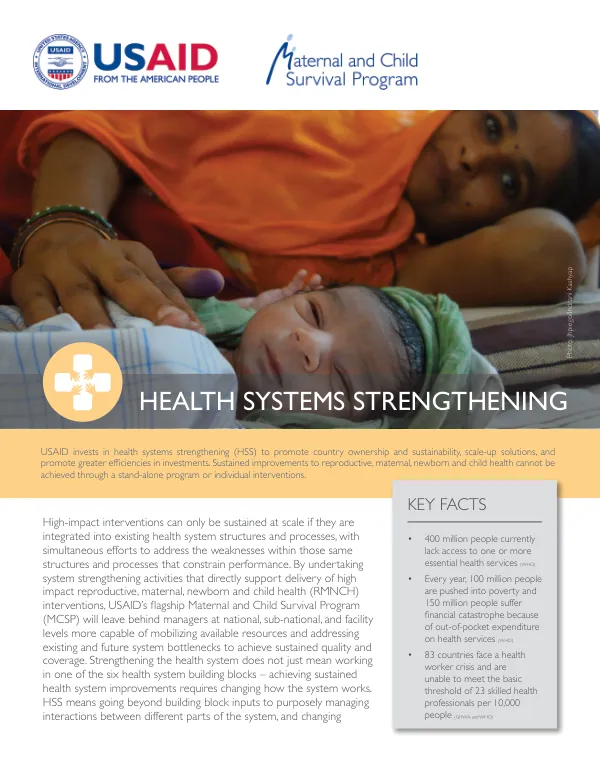
Health systems strengthening (HSS) is a critical component of USAID's efforts to promote country ownership and sustainability, scale-up solutions, and promote greater efficiencies in investments.
2016 · 2 pages
Sign in to readA free account is required to download.
Abstract
Sustained improvements to reproductive, maternal, newborn, and child health cannot be achieved through a stand-alone program or individual interventions. High-impact interventions can only be sustained at scale if they are integrated into existing health system structures and processes, with simultaneous efforts to address the weaknesses within those same structures and processes that constrain performance. The USAID flagship Maternal and Child Survival Program (MCSP) undertakes system strengthening activities that directly support delivery of high-impact reproductive, maternal, newborn, and child health (RMNCH) interventions. By doing so, MCSP aims to leave behind managers at national, sub-national, and facility levels more capable of mobilizing available resources and addressing existing and future system bottlenecks to achieve sustained quality and coverage. Strengthening the health system requires changing how the system works, going beyond building block inputs to purposely managing interactions between different parts of the system, and changing policies, organizational structures, and behaviors that drive system performance to improve equity, coverage, quality, and efficiency. MCSP focuses on barriers that directly affect service delivery, assisting countries to provide high-quality sustainable RMNCH services at scale. The program assists district health managers to identify and alleviate system bottlenecks that constrain high-quality services, ensures decision-makers understand the cost of high-impact RMNCH interventions, and allocates sufficient resources to sustain high coverage and quality at scale. Additionally, MCSP strengthens health worker motivation, support, and accountability systems to complement innovative capacity building methods, ensuring health workers are not only well-trained but also motivated and supported to provide high-quality services, and held accountable to managers and users. According to the World Health Organization (WHO), 400 million people currently lack access to one or more essential health services. Every year, 100 million people are pushed into poverty and 150 million people suffer financial catastrophe because of out-of-pocket expenditure on health services. Furthermore, 83 countries face a health worker crisis and are unable to meet the basic threshold of 23 skilled health professionals per 10,000 people. MCSP identifies and prioritizes addressing the system weaknesses that can have the maximum impact on RMNCH outcomes, piloting HSS approaches that are important to RMNCH performance. MCSP supports programming in maternal, newborn, and child health, immunization, family planning and reproductive health, nutrition, health systems strengthening, water/sanitation/hygiene, malaria, prevention of mother-to-child transmission of HIV, and pediatric HIV care and treatment. The program is focused on ensuring that all women, newborns, and children most in need have equitable access to quality health care services to save lives.