USAID DEC
Healthy Relationships for a Violence Free Future Activity Gender Based Violence (GBV) Training for Faith and Local Leaders, Training Report
Sign inUSAID DEC
Healthy Relationships for a Violence Free Future Activity Gender Based Violence (GBV) Training for Faith and Local Leaders, Training Report
The Healthy Relationships for a Violence-Free Future Activity is a project implemented by World Vision Timor Leste in its Area Program of Covalima, funded by USAID.
2021 · 3 pages
Sign in to readA free account is required to download.
Abstract
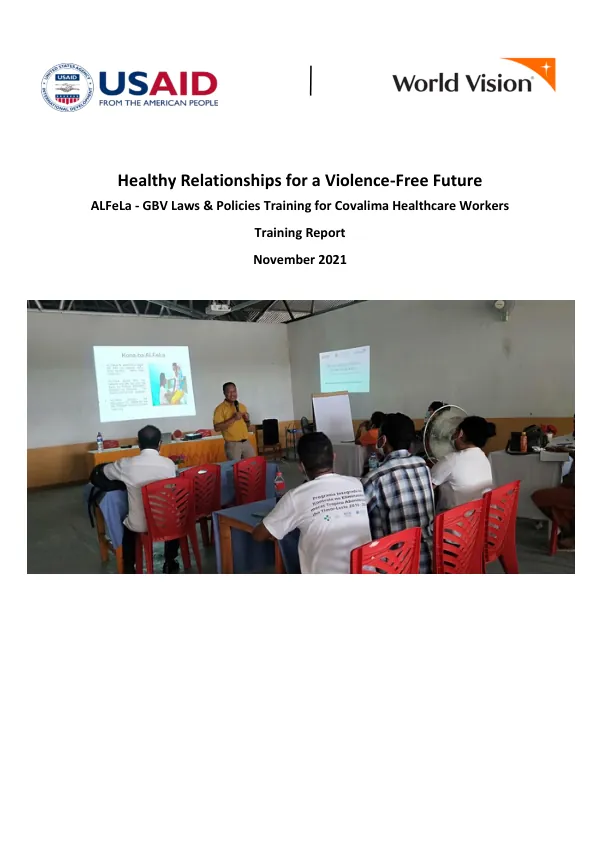
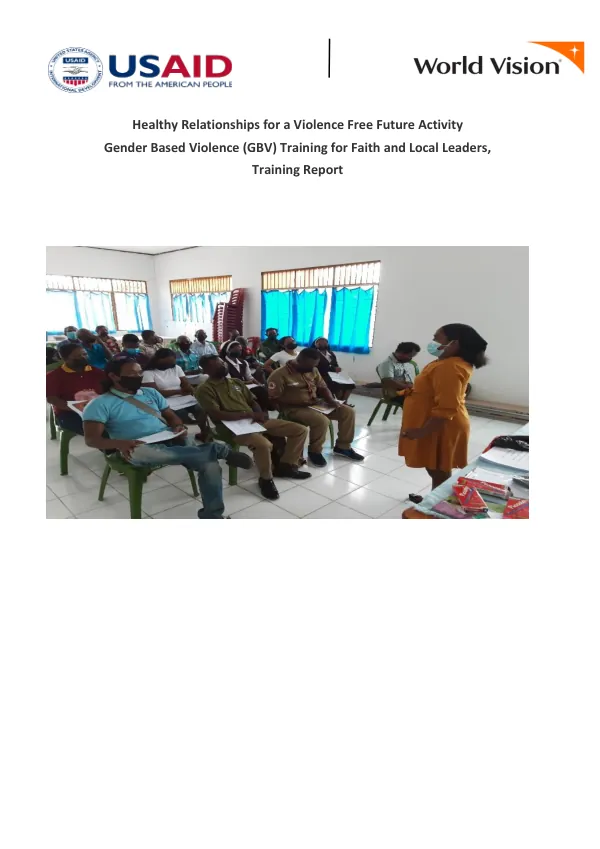
The project aims to positively influence norms related to violence against women and children through working with adolescents, youth, faith leaders, parents, teachers, government, and community organizations. To achieve this goal, the project focuses on preventive measures, including awareness-raising activities, strengthening community service organizations, and advocacy for stronger Gender-Based Violence laws and service improvement. One intervention for strengthening community service organizations is building their capacity on Gender-Based Violence. In early July, the project collaborated with the Ministry of Social Solidarity and Inclusion centre at the Municipal level to deliver Gender-Based Violence training to faith and community leaders of three administrative posts in Covalima. The training was conducted in the administrative posts of Zumalai, Tilomar, and Maucatar, with sessions held on July 7, 8, and 9, 2021, respectively. The training objective was to raise awareness among faith and community leaders on the Gender-Based Violence concept, to have them understand GBV-related issues, and to enable them to distinguish between civil cases and criminal cases. The training also aimed to equip them with the capacity to respond immediately and appropriately in case of identified cases in the community. A total of 49 people participated in the training, with 16 women and the majority being men. They represented the faith and community leaders of 16 villages in the administrative posts of Tilomar, Maucatar, and Zumalai. The training participants were highly interactive, demonstrating a good understanding of the Gender-Based Violence concept. They actively participated in discussions, asked questions, and provided inputs and recommendations, particularly on the case referral mechanism in the absence of the juvenile justice law. The participants suggested inviting guest speakers from the Vulnerable Unit Person of the National Police institution in the next training to provide more insights on case management, especially when minors are involved. However, some community leaders were unable to attend the training due to clashing schedules. The training was facilitated by the Gender-Based Violence officer from the Ministry of Social Solidarity and Inclusion office in Covalima, using their standard module covering topics such as the definition of Gender-Based Violence and its components, the causes of GBV and impacts, child rights and child protection, and case referral pathways. The training materials and facilitation were provided by the Ministry of Social Solidarity and Inclusion, with the project staff supporting the coordination and logistics.