USAID DEC
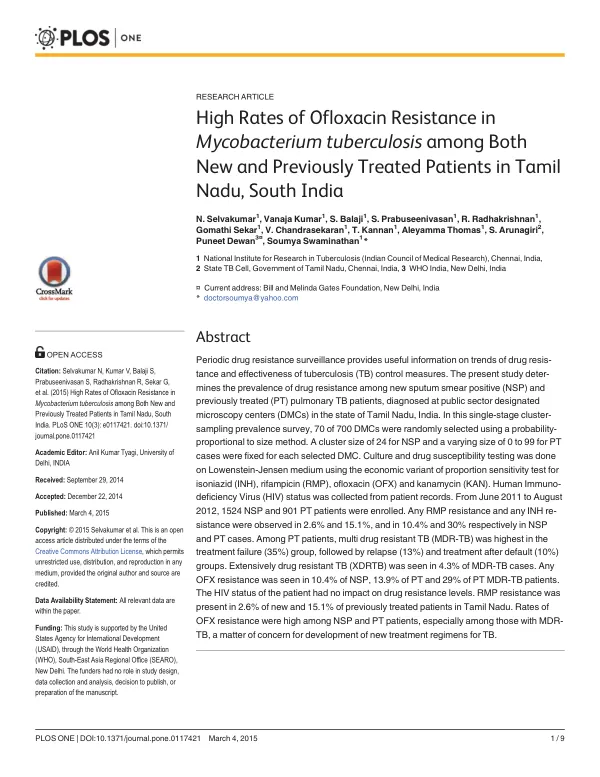
High Rates of Ofloxacin Resistance in Mycobacterium tuberculosis among Both New and Previously Treated Patients in Tamil Nadu, South India
Sign inTHE BILL AND MELINDA GATES FOUNDATION
High Rates of Ofloxacin Resistance in Mycobacterium tuberculosis among Both New and Previously Treated Patients in Tamil Nadu, South India
Tuberculosis (TB) caused by Mycobacterium tuberculosis remains a major public health issue in developing countries, despite scaling up interventions to achieve global control.
2015 · 9 pages
Sign in to readA free account is required to download.
Abstract
The risk of progression of TB is enhanced by human immunodeficiency virus (HIV) infection and malnutrition, especially in Asia and Africa, besides social determinants like poor housing and poverty. In 2011, there were an estimated 8.7 million new cases of TB (13% co-infected with HIV) and 1.4 million TB deaths, including one million deaths among HIV-negative patients and 0.43 million among HIV-positive patients. The emergence of multi-drug resistant TB (MDR-TB) is a major hurdle for TB control programs, especially in developing countries like India. The global report on drug resistance surveillance by the World Health Organization (WHO) estimated that 3.6% of new smear-positive TB (NSP) cases and 20% of previously treated cases (PT) have MDR-TB. Of the total MDR-TB cases, 60% are in just three countries: India, China, and Russia. Therefore, a regular national drug resistance surveillance program is imperative to monitor the levels of drug resistance among NSP and PT cases, and to assess the performance of national TB control programs. A study was initiated to determine the prevalence of MDR-TB and extensively drug-resistant (XDR-TB) among new and previously treated pulmonary TB patients, diagnosed in public sector designated microscopy centers (DMCs) in the state of Tamil Nadu, India. The study also aimed to determine the prevalence of resistance to ofloxacin (OFX) and kanamycin (KAN), two drugs that form the backbone of second-line treatment, and which have not been investigated previously. The study period was from May 2011 to August 2012. The study design was a cross-sectional cluster survey, which considered the annualized number of NSP and PT smear-positive pulmonary TB cases diagnosed in each of the DMCs in the state of Tamil Nadu. A random sample of 70 DMCs (10%) was selected from the list of 700 DMCs by probability-proportional to size (PPS) method. A cluster size of 24 NSP was fixed for each of the selected DMC, while clusters of varying sizes (0-99) were fixed for PT patients for each of these DMCs selected. Consecutive eligible NSP and PT cases were enrolled, and sputum was stained by the hot Ziehl-Neelson method and examined as per the RNTCP procedures. The study found that any rifampicin resistance and any isoniazid resistance were observed in 2.6% and 15.1%, and in 10.4% and 30% respectively in NSP and PT cases. Among PT patients, multi-drug resistant TB (MDR-TB) was highest in the treatment failure (35%) group, followed by relapse (13%) and treatment after default (10%) groups. Extensively drug-resistant TB (XDR-TB) was seen in 4.3% of MDR-TB cases. Any ofloxacin resistance was seen in 10.4% of NSP, 13.9% of PT, and 29% of PT MDR-TB patients. The HIV status of the patient had no impact on drug resistance levels. The study highlights the high rates of ofloxacin resistance among NSP and PT patients, especially among those with MDR-TB, which is a matter of concern for the development of new treatment regimens for TB.
Related documents
Documents in this collection
 2015
2015USAID DEC
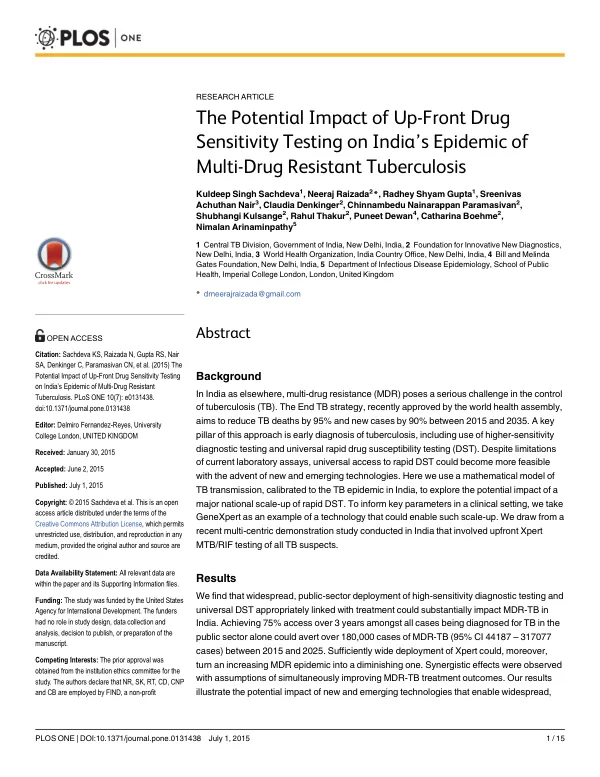
The Potential Impact of Up-Front Drug Sensitivity Testing on India’s Epidemic of Multi-Drug Resistant Tuberculosis
Open record 2015
2015USAID DEC