USAID DEC
The Potential Impact of Up-Front Drug Sensitivity Testing on India’s Epidemic of Multi-Drug Resistant Tuberculosis
Sign inTHE BILL AND MELINDA GATES FOUNDATION
The Potential Impact of Up-Front Drug Sensitivity Testing on India’s Epidemic of Multi-Drug Resistant Tuberculosis
The End TB strategy, approved by the world health assembly, aims to reduce TB deaths by 95% and new cases by 90% between 2015 and 2035.
2015 · 15 pages
Sign in to readA free account is required to download.
Abstract
A key pillar of this approach is early diagnosis of tuberculosis, including universal drug susceptibility testing, and systematic screening of high-risk groups. In India, despite impressive progress in the scale-up of DOTS coverage by the public sector, tuberculosis remains a pressing public health problem. The timely ascertainment of drug sensitivity presents additional challenges, as most current methods for drug susceptibility testing (DST) are reference laboratory-based and do not lend themselves to widespread use amongst patients at initial diagnosis of TB. The End TB strategy targets to reduce TB deaths by 95% and new cases by 90% between 2015 and 2035. One of the key pillars of this approach is early diagnosis of tuberculosis, including universal drug susceptibility testing, and systematic screening of high-risk groups. New and emerging technologies could make it feasible to meet such conditions, by lifting the constraints associated with current methods of DST, thereby extending high-quality DST to an increased number of patients. A prominent example of such technology is the Xpert MTB/RIF assay, a rapid highly-automated nucleic acid amplification test that can provide a highly-accurate result on M. tuberculosis presence in sputum and rifampicin-resistance status within 2 hours. The Xpert MTB/RIF assay has the potential to decentralize DST to the district or sub-district level, offering the potential for much wider, timelier DST than is feasible with current tools. Moreover, while conventional DST is performed only after TB diagnosis, an assay such as Xpert allows DST to be run concurrently with diagnosis: this is referred to as 'upfront' DST. Widened access to upfront DST could lead to earlier detection of MDR-TB, particularly amongst smear-negative cases in which it would otherwise be missed. When linked to effective treatment, this improved detection could lead to reduced opportunities for transmission, thus potentially preventing future cases of MDR-TB. A recent study addressed the potential impact of Xpert in the TB epidemic in India, highlighting the importance of engaging the private sector in controlling TB transmission. The present study builds on this to further explore the role of Xpert in the public sector for the control of MDR-TB. We use a transmission modeling framework to address these questions, capturing the indirect effects of expanding DST eligibility, earlier MDR diagnosis, and better coverage of diagnostic and treatment services under the RNTCP. The model is calibrated to the TB and MDR-TB epidemic in India, and results are presented for the potential impact of Xpert at different levels of access.
Related documents
Documents in this collection
 2015
2015USAID DEC
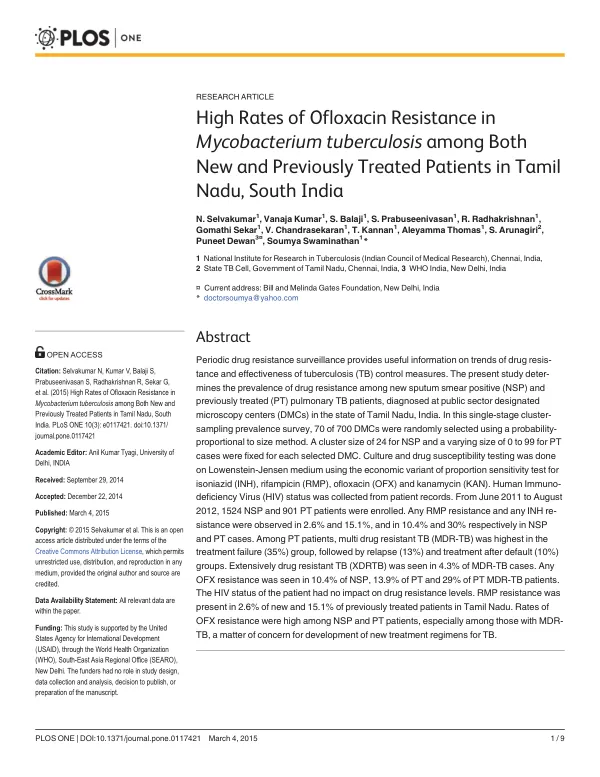
High Rates of Ofloxacin Resistance in Mycobacterium tuberculosis among Both New and Previously Treated Patients in Tamil Nadu, South India
Open record 2015
2015USAID DEC