USAID. MISSION TO PERU
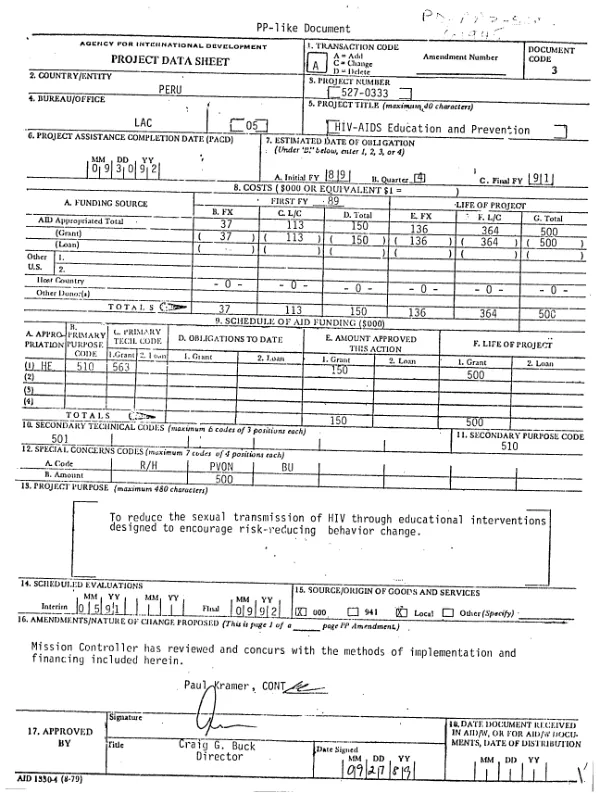
HIV-AIDS education and prevention
Project, follow-on to 5270327, to reduce the sexual transmission of AIDS in Peru through educational interventions.
1989
Sign in to readA free account is required to download.
Abstract
Proyectos en Informatica, Salud, Medicina y Agricultura (PRISMA), a Peruvian PVO, will implement the project in cooperation with three other institutions: the Special AIDS Control Program of the Ministry of Health (PECOS), the Institute of Tropical Medicine at San Marcos University (ITM/SMU), and the Peruvian Homosexual Community Services Organization (MHOL). A.I.D./W"s AIDSTECH and AIDSCOM programs (project 9365972) will provide TA. First, the project will support a workshop for health educators on developing AIDS-related IEC materials. Participants will include representatives of the implementing institutions and of local PVO"s (e.g., Generacion, Peru-Mujer). The workshop will focus on developing a basic AIDS information pamphlet based on audience research. Materials developed will be pretested and adapted for distribution by each participating organization. Second, the project will develop an AIDS prevention strategy that targets young women aged 14-20. In collaboration with local women"s organizations and other information networks, PECOS will conduct research through focus groups and in-depth interviews, produce communications materials, and train peer or professional educators. The materials produced will be distributed in the Callao and Lima sexually transmitted disease (STD) clinics, the ITM/SMU testing center, and other health education institutions. Third, the project will develop strategies which target high-risk males. MHOL will continue three activities begun under -0327. (1) The Si"dayuda hotline will provide AIDS information to the public and serve as a data collection service to help identify specific information and service needs. (2) The Pasa La Voz peer educator program in Callao will support street-oriented outreach and one-day AIDS education workshops. (3) Safer Sex Workshop series will provide in-depth AIDS education free of charge to high-risk men in Lima. Additionally, ITM/SMU will target male clients of prostitutes in Callao through a strategy which includes KAP surveys, printed material development, and condom distribution. Fourth, the project will establish an anonymous/confidential HIV antibody testing and counseling center at ITP/SMU. Two counselors or social workers will initially be trained in pre- and post-test counseling, with an additional counselor added each year over the life of the project. The counseling staff will serve approximately 5 new clients daily and assess the impact of testing/counseling on subsequent behavior. In addition, one of the counselors will assist the Callao STD clinic staff by helping distribute free contraceptives and provide AIDS education and counseling. ITP/SMU will collect demographic data related to the epidemiology of AIDS in Peru. Finally, the project will work with local women"s groups to study specific AIDS risk factors for women and identify possible educational strategies.
Related documents
![FLAS/[HOPE] HIV AIDS prevention project](https://covers.devme.ai/gen/24881.webp)
![AIDS communications and technical services (ACTS) (supplement) [: amendment no. 1] -- phase two plan of activities](https://covers.devme.ai/gen/29655.webp)