USAID DEC
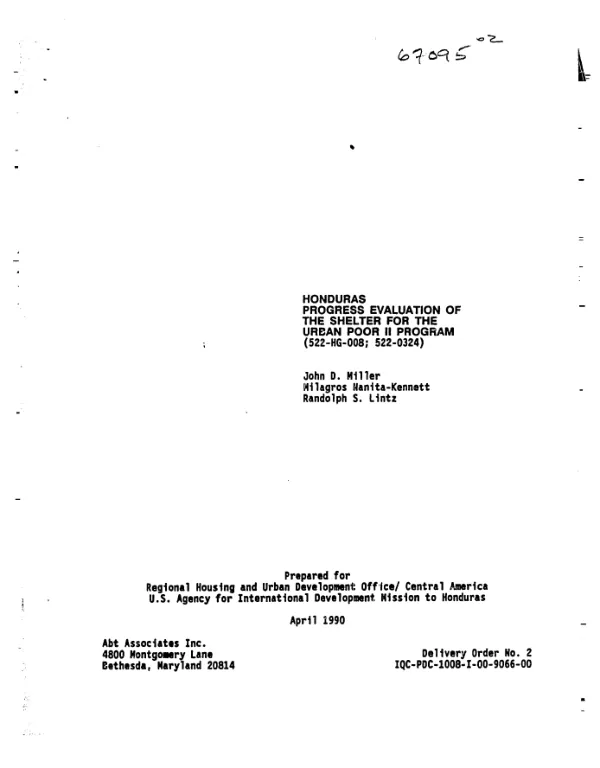
Honduras : progress evaluation of the shelter for the urban poor II program (522-HG-008, 522-0324)
Sign inABT ASSOCIATES, INC.
Honduras : progress evaluation of the shelter for the urban poor II program (522-HG-008, 522-0324)
Interim evaluation of a Housing Guaranty/TA program to improve the institutional capacity of the Honduran private sector and of the municipal governments of seven cities to provide housing, infrastructure, and public services for low-income families.
Miller, John D.|Nanita-Kennett, Milagros|Lintz, Randolph S. · 1990
Sign in to readA free account is required to download.
Abstract
Evaluation covers the period 9/86-3/90. The program is progressing toward its physical output targets. More than 12,000 low-income persons have been provided with water and sewerage systems or mortgages for new housing; nearly 20,000 persons will soon benefit from projects in process; and an estimated 3,000 persons will benefit from projects not yet started. Infrastructure activities have: contributed to increased earnings for small businesses and increased land and home values; encouraged residents to make home improvements; provided construction jobs; improved environmental and sanitary conditions; and encouraged the formation of neighborhood improvement groups. new policy changes, especially in San Pedro Sula, to promote the participation of the private sector in urban development. On the negative side, project execution is constrained by macroeconomic conditions that limit domestic resource mobilization. The amount of mortgage credit available is still only a fraction of what is required. Other problems include the lack of formal mechanisms for cost recovery and the insufficient capacity of municipalities for maintaining water and sewerage systems (with the exception of San Pedro Sula). The project has demonstrated that the private sector will participate in urban service delivery as long as the public sector provides a suitable framework. In San Pedro Sula, for example, private sector commitments were made after land use standards were modified and in-kind contributions were made. The participation of private housing finance institutions, on the other hand, has been limited. One major obstacle is the lack of interest among S&L's in lending to low-income clients. NGO's are the most viable intermediaries for reaching low-income households, but they are typically unable to access the Fondo de la Vivienda's (FOVI) rediscount facilities because their low-income clients are unwilling to put up their houses as collateral on home improvement loans, as is required by FOVI. Long-term TA has been well balanced between project implementation and specific technical and management assistance. Short-term TA provided by the Unidad de Coordinacion y Asistencia Technica, on the other hand, has generally not been effective. Dramatic differences exist among the seven participating municipalities. Future projects should be sure to collect baseline data for use in evaluating project impacts.