USAID. BUR. FOR LATIN AMERICA AND THE CARIBBEAN. REGIONAL HOUSING AND URBAN DEVELOPMENT OFC.
Housing sector alternatives for low income groups
ES summarizes attached study (XD-AAX-596-A) of low-income housing in Jamaica.
1988
Sign in to readA free account is required to download.
Abstract
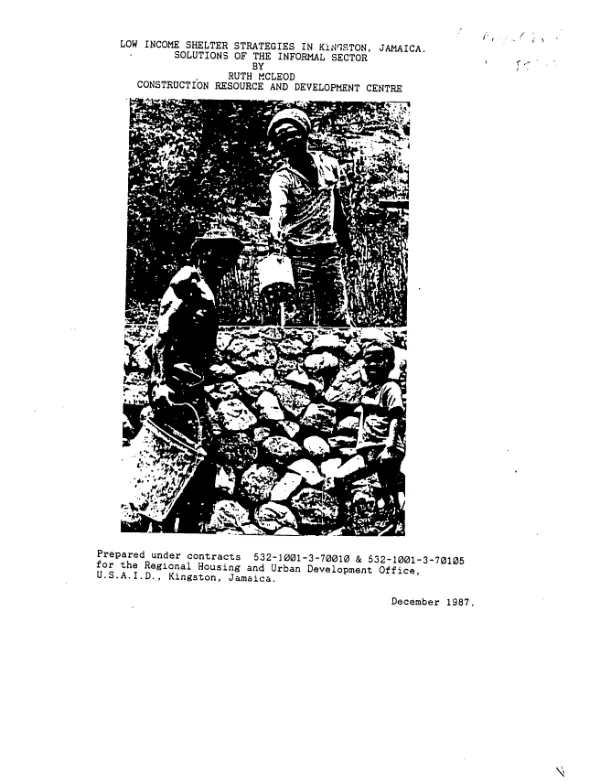
The study provides data relating to the broad issue of acquisition and construction of housing by lower-income groups by both formal and informal means. Specifically, the study seeks to understand how low-income people in Kingston make decisions concerning shelter investment, how they obtain construction materials, provide labor, build their shelter and finance all of these activities. The study, based on a survey of 677 low-income households in the Kingston area and on a series of in-depth case studies of similar households, examines areas such as household constitution and occupations, mobility and density, land tenure, the building process, the physical and social infrastructure, savings, expenditure and credit patterns and respondents views on their own situation. Major findings include: (1) close to 70% of the housing built in Jamaica between 1970 and 1980 was built as part of the informal development process, i.e., outside the regulatory environment of Town Planning, public housing schemes, and formal institutional financing; (2) the single most important constraint on adequate low-income shelter is access to land; (3) 41% of sample households were headed by females and 60% of respondents were unemployed or underemployed; (4) people generally built and improved their shelter over an extended period of time; (5) respondents who owned, leased, or squatted upon land (as opposed to those renting housing) were strongly motivated to upgrade their shelter - these respondents also had a perceived security of tenure, despite the lack of legal tenure; (6) expenditures for shelter were relatively low; and (7) most respondents did not save at all and 33% of those who did save did so with the informal "partners" system. The findings of the study will form the basis for the design of future programs to respond to low-income housing needs in Jamaica, and will indicate directions to be taken in some of the activities of the HG-012 Housing Guaranty Loan recently borrowed by the Jamaican government.
Related documents