USAID. BUR. FOR AFRICA. OFC. OF SUSTAINABLE DEVELOPMENT. AFRICA BUREAU INFORMATION CENTER (ABIC)
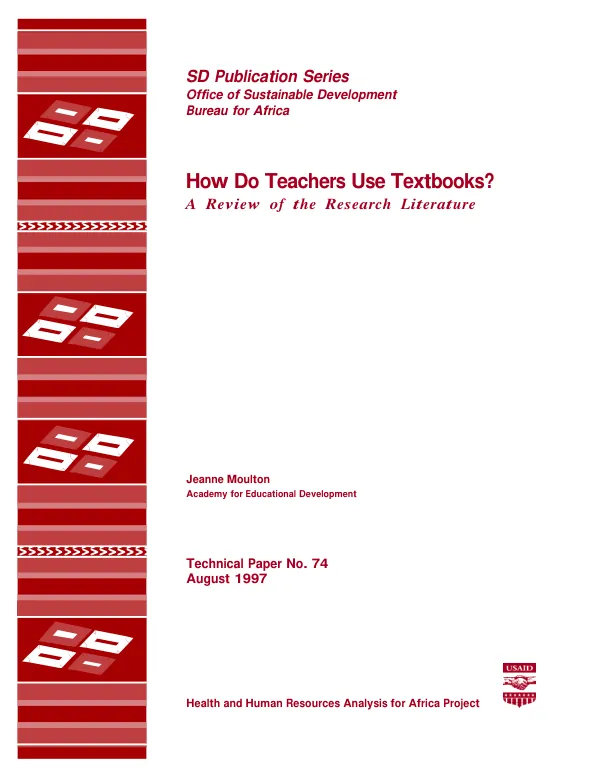
How do teachers use textbooks? : a review of the research literature
When educators conduct research on textbooks, they most often look at the quality of the books -- their content and format -- and their appropriateness for students in terms of level of vocabulary and ethnic and gender biases.
Moulton, Jeanne · 1997
Sign in to readA free account is required to download.
Abstract
But what does it matter what the books say if students do not learn from them? Educators must know, based on evidence, how teachers use textbooks and how this use aids student learning. This update of a 1994 literature review (see PN-ABZ-282) examines both research findings on how teachers use textbooks and the empirical methods that have been used to obtain these findings. The report first reviews research on the availability and use of textbooks in primary schools in developing countries, then research on textbook use in elementary schools in the United States. A summary is then presented of the kinds of research questions that have been posed and the methods used to answer them. A concluding section discusses the applicability of this review to planning educational research in Africa. Major findings are as follows. (1) Teachers develop their own patterns of using textbooks, which they keep from year to year and from textbook to textbook. (2) The patterns vary considerably from teacher to teacher, as do the reasons teachers adopt them. (3) While policymakers and others outside the classroom tend to think that textbooks dominate the classroom, teachers often view textbooks as only one of several tools. Some use them effectively; others may misuse them. (4) It is difficult to determine teachers" use of and attitudes towards textbooks without actually observing the teachers and asking them questions. Includes bibliography. (Author abstract, modified)
Related documents
Documents in this collection
![Overlooked and undervalued : a synthesis of ERNWACA [Educational Research Network for West and Central Africa] reviews on the state of educational research in West and Central Africa](https://covers.devme.ai/gen/65178.webp) 1997
1997USAID DEC
Overlooked and undervalued : a synthesis of ERNWACA [Educational Research Network for West and Central Africa] reviews on the state of educational research in West and Central Africa
Open record 1990
1990USAID DEC