USAID DEC
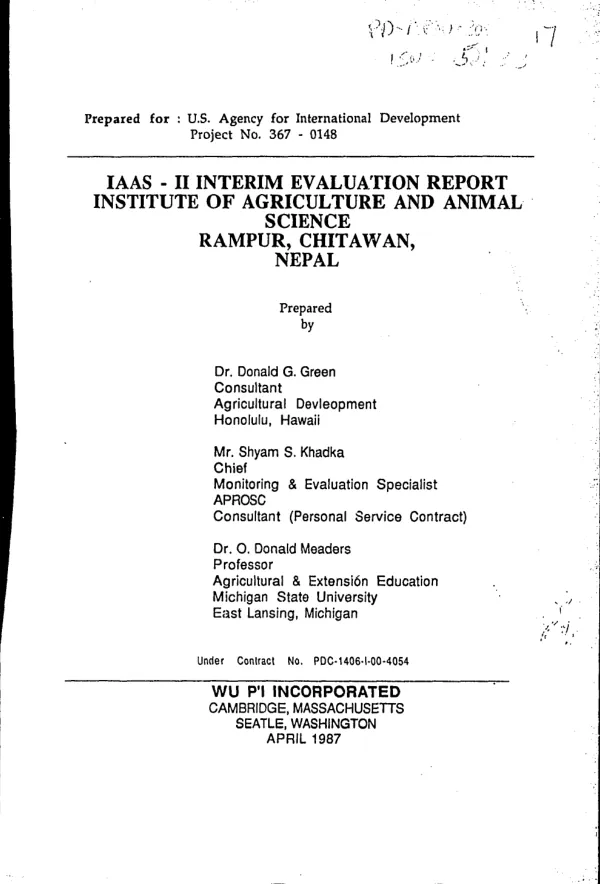
IAAS-II interim evaluation report : Institute of Agriculture and Animal Science, Rampur, Chitawan, Nepal
Sign inWU P'I, INC.
IAAS-II interim evaluation report : Institute of Agriculture and Animal Science, Rampur, Chitawan, Nepal
Evaluates project to upgrade Nepal's Institute of Agriculture and Animal Science (IAAS).
Green, Donald G.|Khadka, Shyam S.|Meaders, O. Donald · 1987
Sign in to readA free account is required to download.
Abstract
Interim evaluation covers the period 7/84-4/87 and is based on site visits, interviews with Government of Nepal (GON) and other officials, and document review. The project is making definite progress toward its objectives, despite some delays. Especially impressive have been the project's faculty development efforts: there are currently 31 faculty members with B.S.'s, 78 with M.S.'s, and 16 Ph.D.'s, but when those currently on study leave return, these figures will become 23, 71, and 31, respectively. The additional Ph.D.'s are needed not only to strengthen IAAS - Nepal's only institution of higher education in agriculture - but also to fulfil key IAAS goals of initiating selected M.Sc. programs and securing Royal Charter status from the GON. Nonetheless, even more Ph.D. training is needed. U.S. training, while more expensive than schooling in India or the Philippines, is recommended for the valuable linkages which it affords. Much evidence suggests IAAS's committment to playing an active role in Nepal's agricultural development: the drive to obtain Royal Charter status, for example, and IAAS's expanding role in research (including joint research with other entities). IAAS is also beginning to explore the possibility of contracting its services to agricultural development projects, which would further enhance faculty development. On the other hand, IAAS leadership needs to establish a planning unit, to finalize and implement a farm development plan (rules permitting IAAS to utilize farm-generated income should be an incentive here, if IAAS's budget is not cut, concomitantly), and to continue pressing on budget allocations for recurring costs. A planning unit would not only strengthen IAAS planning at the departmental level, but would also help to prioritize IAAS needs so that they can be met incrementally and to package them so that they are attractive to donors. Other needs are to: strengthen the role of the Academic Administration Advisor in the planning process and in establishing links between IAAS and the Ministry of Agriculture; and improve the Junior Technical Assistant program, especially in the area of practical skills training.