USAID DEC
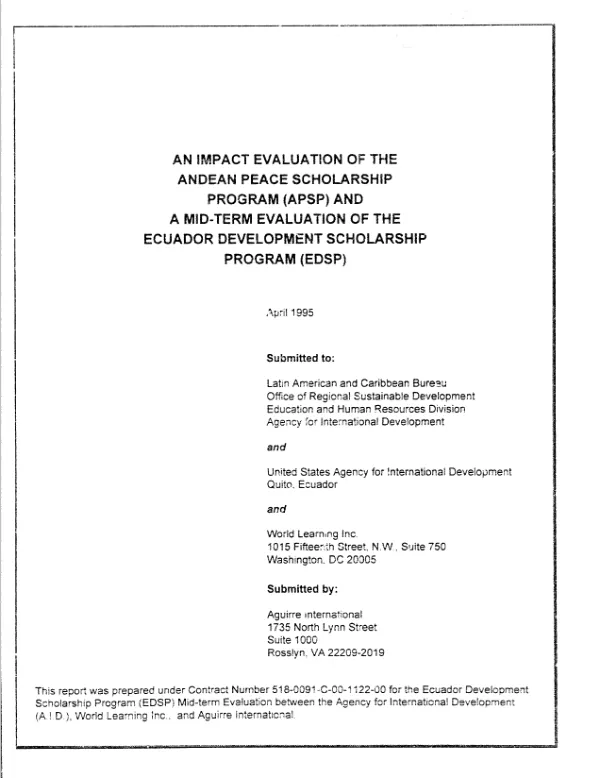
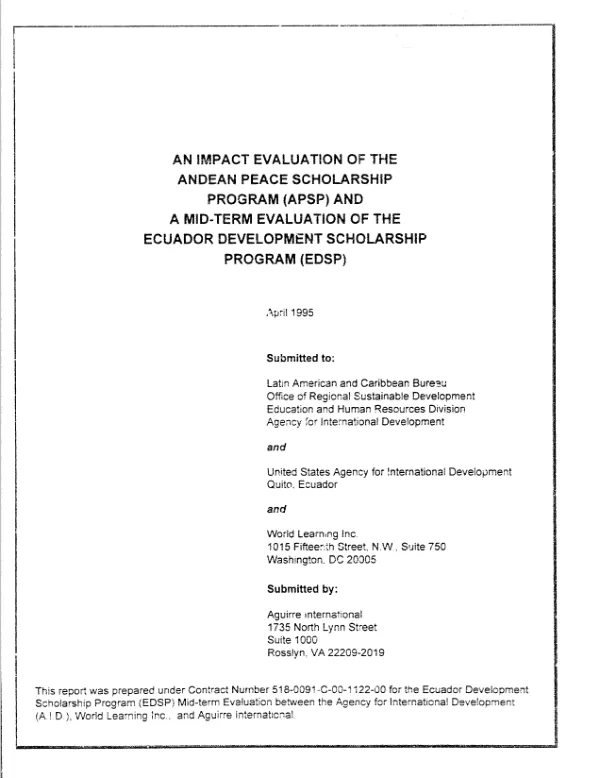
Impact evaluation of the Andean peace scholarship program (APSP) and a mid-term evaluation of the Ecuador development scholarship program (EDSP)
Sign inAGUIRRE INTERNATIONAL
Impact evaluation of the Andean peace scholarship program (APSP) and a mid-term evaluation of the Ecuador development scholarship program (EDSP)
Evaluates the impact of two participant training projects in Ecuador: the completed Andean Peace Scholarship Program (APSP) (1987-9/93), and the ongoing Ecuador Development Scholarship Program (EDSP), which began in 1991.
1995
Sign in to readA free account is required to download.
Abstract
The evaluation is based in part on survey interviews with 54 APSP and 94 EDSP trainees and on focus group interviews with trainees grouped by field of study. The final evaluation of APSP showed that over 75% of trainees are currently working in their original place of employment, 85% are successfully using new skills and knowledge, and 93% are using project design course work for international development. Some participants moved into high visibility positions, increasing the extent to which they can share their knowledge (multiplier effect) and influence business and government policy. Additionally, program trainees: (1) received good orientation and felt prepared for U.S. training, but also needed more information about U.S. academic life in general and their particular course of study; (2) found the training met their high academic level and was transferable to their own Ecuadoran sector, with the exception of the Spanish language program at the University of New Mexico, which was not sufficiently rigorous and did not improve trainees" English language skills; and (3) in some instances, could not complete their degrees because all had to return to Ecuador by the PACD. By participating actively in the Experience America program, trainees established contacts with U.S. counterparts and expanded their world view and ability to operate as change agents upon their return. Results of the follow-on program were mixed. On the positive side, the in-country contractor provided trainees with an excellent re-entry seminar and excellent short courses and seminars leading to the legal establishment of the Alumni Association as a non-profit organization; and returnees have written four books related to agriculture, health, environment, and education issues in Ecuador, which are used in schools and development projects across the country. On the negative side, sources of information through which trainees can continue to build their skills and knowledge are limited in Ecuador; given USAID"s substantial investment in training these outstanding professionals, it would be a mistake not to provide the relatively small outlays needed to provide access to technical publications and the Internet. Also on the debit side, the Alumni Association is not yet fully operational; membership is extremely heterogeneous and trainees are dispersed throughout the country. The mid-term evaluation of the EDSP program reveals that over 50% of the program participants are women (in excess of the 40% target), while the majority are disadvantaged (82%). Short-term courses have been well-designed (except for those aimed at women"s agricultural leaders and at natural resource managers) and have provided trainees with skills which they have used immediately upon return. The innovative use of in-country counterpart organizations to recruit candidates, design training, and contribute to follow-on has proven effective and has helped develop the organizations institutionally, while expanding USAID"s outreach into the community. In addition, the majority of U.S. training institutions have used state-of-the art training programs geared to the needs of Ecuadoran students. Trainees have been very satisfied with follow-on courses, although they have requested that the courses be scheduled more frequently. All in all, the program at its mid-point is on target for achieving its goals: the average employment rate for returnees is 87%, and 91% of those employed are employed in their field of training. Most trainees (93%) are applying new skills in the workplace, some 78% have increased their job responsibilities, over 90% believe they have increased their leadership capacity, and over 70% remain in touch with the United States through professional journals. Finally, the program has contributed to trainees" understanding of democratic institutions and economic growth. For example, the small farmers" association group ignited a spirit of small business development among trainees, and, together with a follow-on training program in marketing, resulted in increased production and sales for the farmers. In a similar vein, the courses for community leaders (health supervisors, auxiliary nurses, natural resource managers, and Amazon community leaders) focused in-depth on community involvement as a foundation for democratic society. It is recommended that other projects complement the training of grassroots and disadvantaged leaders funded under this project by training policymakers and operational managers in the same sectors.
Related documents
Documents in this collection
 1995
1995USAID DEC
Impact evaluation of the Andean peace scholarship program (APSP) and a mid-term evaluation of the Ecuador development scholarship program (EDSP)
Open record 1991
1991USAID DEC