USAID. BUR. FOR PROGRAM AND POLICY COORDINATION. CENTER FOR DEVELOPMENT INFORMATION AND EVALUATION (CDIE)
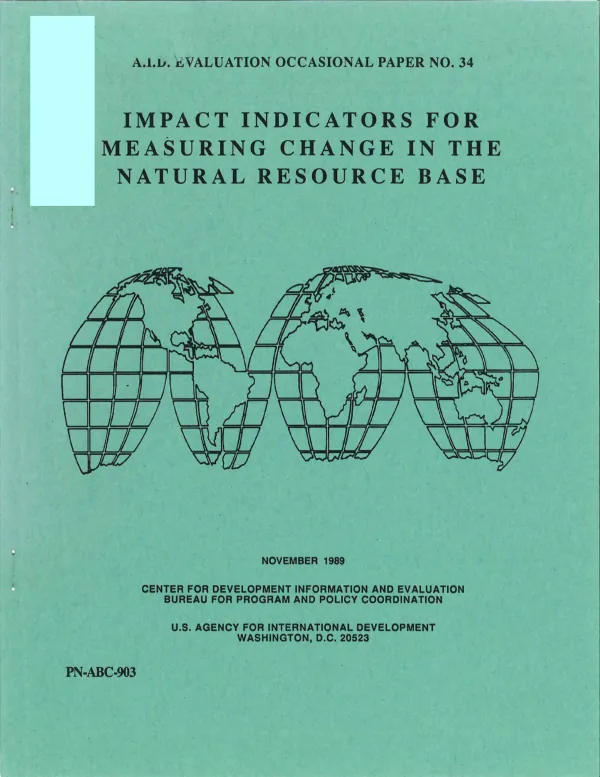
Impact indicators for measuring change in the natural resource base
This paper identifies and describes several impact indicators that can be used to evaluate changes in the natural resource base over time -- changes that may be associated with development efforts.
McCracken, Ralph J. · 1989
Sign in to readA free account is required to download.
Abstract
Specifically, the impact indicators include: six soil resource indicators (to measure water- and wind-caused erosion, soil productivity and degration, land use, and run- off), five water resource indicators (to measure availability of ground and surface water, upstream flooding, irrigation efficiency, surface water pollutants, and groundwater contamination), four plant resource indicators (to assess local farming practices, the carrying capacity of rangeland, and the status of forests and wetlands), and two ecosystem indicators (to evaluate general ecological deterioration, and to measure the relative productivity in calories of food produced in a soil-plant ecosystem). The document also provides a checklist of baseline data needed to implement the indicators. It is not feasible to use a common set of impact indicators for all interventions, the document concludes; variations in climate, soil, and vegetation in different locations and over time require different sets of indicators.
Connected topics
![MANRES [management of natural resources and the environment] assessment : final report](https://covers.devme.ai/gen/6413.webp)