POPULATION COUNCIL
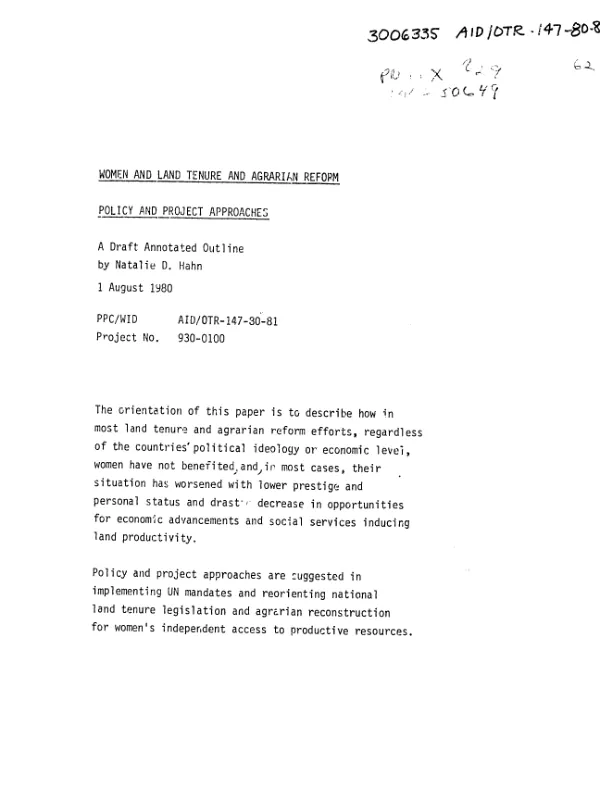
Impact of agrarian reform on men and women in Honduras
The impact of agrarian reform in Honduras on men and women is examined in this report.
Safilios-Rothschild, Constantina · 1983
Sign in to readA free account is required to download.
Abstract
The study is based on a survey of 32 asentamientos (settlements) throughout the country and case studies of 4 of them. The objective of establishing equitable distribution of land to the landless has not been met. Many families have less than the 6 manzanas considered the minimum viable amount of land, and in general men have benefited much more from agrarian reform than women. Specifically, (1) Women have received little or no TA/training for their women"s groups and no TA or credit for their income-generating projects, and have less access to land and work opportunities in asentamientos than in their communities of origin (typically, the existence of women"s groups seems to be related inversely to the men"s degree of formal organization -- the most active women"s groups exist in asentamientos in which men are not organized in cooperatives or pre- cooperatives). (2) Female heads of household have not benefited equally with male heads of household, and, in fact, have only profited when there were grown-up sons to perform agricultural tasks. (3) While agrarian reform appears to be successful in equalizing boys" and girls" access to schooling, it has not boosted men"s and women"s access to agricultural, organizational, and managerial training. (4) Agrarian reform has had a much greater impact on literate farmers who chose asentamientos with good ecological conditions and consistently produce export crops (with government assistance) than on illiterate farmers who become stuck in unfavorable ecological regions and receive little outside assistance. The study found that the type of farming system (individual, collective, or mixed) and the particular mix between individual and collective cultivation is a crucial determinant of the type of asentamiento and the opportunities it offers its members. A mixed farming system with 50%-75% of the land cultivated collectively and the remainder divided into individual lots represents the best type of system for Honduras, as it reconciles the peasant preference for individual land with the economic advantages of collective farming. Asentamientos without collective farming do not organize into cooperatives and thus tend to remain outside development assistance efforts.
![Impact of agrarian reform on men and women in Honduras [: appendices]](https://covers.devme.ai/gen/26389.webp)