USAID DEC
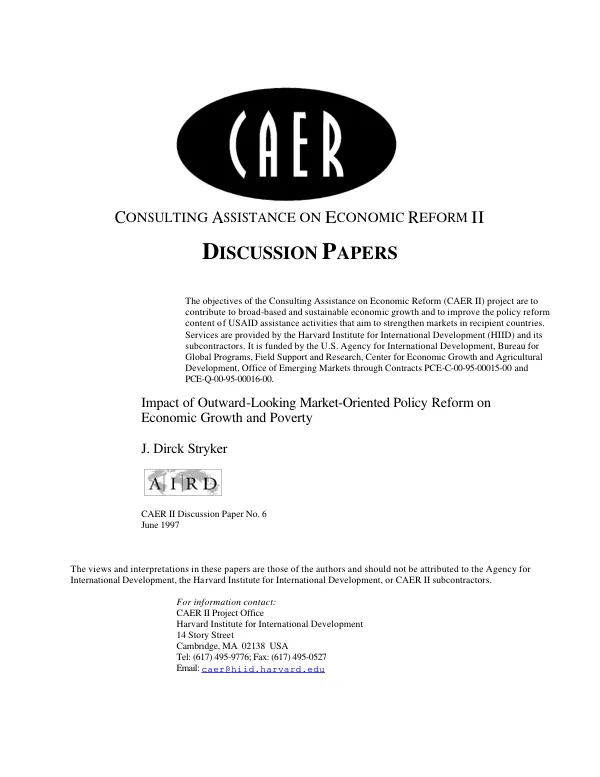
Impact of outward-looking, market-oriented policy reform on economic growth and poverty : presentation paper
Sign inHARVARD UNIVERSITY. HARVARD INSTITUTE FOR INTERNATIONAL DEVELOPMENT (HIID)
Impact of outward-looking, market-oriented policy reform on economic growth and poverty : presentation paper
A recent econometric study across a broad spectrum of developing countries for the period 1974-93 found that outward-looking, market-oriented policy reform stimulates trade and economic growth and promotes poverty alleviation.
Stryker, J. Dirck · 1997
Sign in to readA free account is required to download.
Abstract
This paper summarizes the results of that study and discusses its implications for USAID and other donor programs. The paper begins by reviewing policy reforms undertaken in the past few years, why these reforms should contribute to economic growth through expanded marketing and trade, what conditions are necessary for this to occur, why economic growth should reduce poverty, and what factors might prevent this from happening. Study results are then presented, as follows. (1) Donor emphasis on economic policy reform is indispensable for economic growth. Although a policy environment enabling trade and marketing to flourish may not be a sufficient condition for economic growth and poverty alleviation, it is an essential one. Absent such an environment, donor efforts to aid developing countries will be frustrated. (2) Not only does economic growth help alleviate poverty, but the policies that promote economic growth help the poor. Free market policies benefit the poor, who have only limited access to markets that are tightly regulated or closed. Lower trade taxes increase the prices of exports produced in rural areas, where most of the poor live, and decrease the prices of imported goods, which they buy with their export proceeds. (3) Low levels of education and lack of institutional development are prominent factors inhibiting the expansion of trade in response to policy reform. This supports the investment that USAID has made to promote trade by developing professional associations, strengthening customs administration, identifying non-tariff trade barriers, exploring overseas market opportunities for nontraditional and other exports, and enhancing exporters" access to capital. (4) There is evidence to suggest that improving rural infrastructure through the construction, rehabilitation, and maintenance of rural roads has important implications for poverty alleviation. Beyond these findings, the analysis shows that it is possible to measure quantitatively the impact of policy reform and indicators of development on trade, growth, and poverty.