USAID DEC
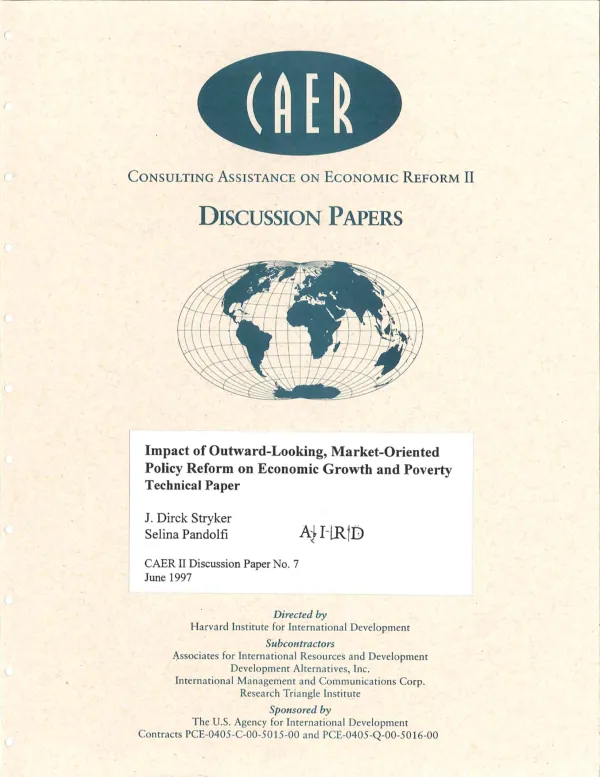
Impact of outward-looking, market-oriented policy reform on economic growth and poverty : technical paper
Sign inHARVARD UNIVERSITY. HARVARD INSTITUTE FOR INTERNATIONAL DEVELOPMENT (HIID)
Impact of outward-looking, market-oriented policy reform on economic growth and poverty : technical paper
To test the assumption that market-oriented policy reform stimulates trade and economic growth even in poorer countries, an econometric study was conducted across a broad spectrum of developing countries for the period 1974-1993.
Stryker, J. Dirck; Pandolfi, Selina · 1997
Sign in to readA free account is required to download.
Abstract
The study begins by developing a number of hypotheses (detailed more fully in an annex) regarding linkages between policy reform, trade, growth, and poverty alleviation, and then discusses the econometric approach used, which was to divide the data into 5-year epochs roughly corresponding to different world economic conditions facing developing countries over a 20-year period. Results provide strong support for most of the hypotheses, as follows. (1) Outward-looking, market-oriented policy is vitally important in promoting trade, growth, and poverty alleviation. All three policy measures have an important influence on the ratio of trade to GDP; this in turn has a positive effect on economic growth, which is important in alleviating poverty. More open policies also have a positive effect on economic growth independent of their influence on trade, and both lower trade taxes and more open policies have a favorable effect on poverty alleviation. (2) Among the development variables, education and institutional development are important for stimulating trade. (3) Regarding the structural variables, trade is most important for economies in which the size of markets is limited. On the other hand, higher population density contributes positively to trade -- the inability to satisfy the need for primary products from domestic sources alone forces countries to manufacture goods that they can exchange for primary product imports -- and, somewhat surprisingly, to growth of per capita GDP. (4) Other findings are that: improvements in the terms of trade have a positive but weak impact in economic growth; being landlocked in and of itself impedes neither trade nor growth (this finding is very robust); poverty alleviation appears negatively correlated with population density; and outward-looking, market-oriented policies help alleviate poverty not only indirectly, by stimulating trade and growth, but directly, since they tend to favor those in the countryside, where poverty is concentrated. Policy implications for USAID and other donors are detailed in conclusion. Includes references.