USAID DEC
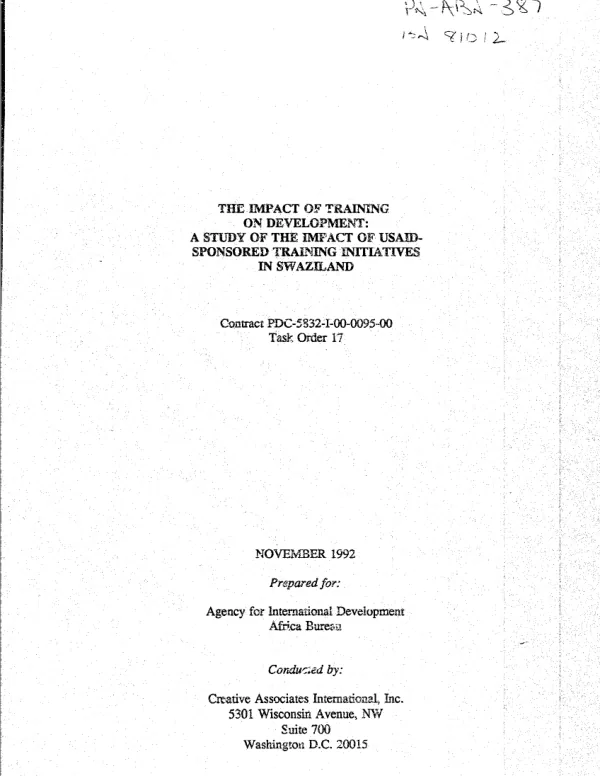
Impact of training on development : a study of the impact of USAID-sponsored training initiatives in Swaziland
Sign inCREATIVE ASSOCIATES INTERNATIONAL, INC. (CAII)
Impact of training on development : a study of the impact of USAID-sponsored training initiatives in Swaziland
Since 1971 USAID/Swaziland has implemented 41 projects containing training components and supported numerous graduate and undergraduate degree programs in-country and abroad.
1992
Sign in to readA free account is required to download.
Abstract
This study assesses the long-term impact of the training on Swaziland's development (impact is defined as change in quality of life) through case studies of: (1) the National Curriculum Center; (2) the Swaziland Institute of Health Sciences; (3) Malkerns Research Station; (4) the Central Bank; (5) the Family Life Association of Swaziland and other NGO training; and (6) three private companies -- Usutu Pulp, the Gama Associates engineering firm, and Swazi Brake and Clutch. While direct results were easily measured and obviously beneficial -- a total of 857 individuals have been trained, 32% of whom are women, and most have remained in the fields in which they were trained -- long-term development impact was more difficult to measure: 98 interviews were conducted, institutional in-house focus groups of training participants were held, and project documentation was reviewed. Conclusions hold that while this training may not immediately have contributed to development, it has laid the necessary foundation for development in the future. Training is most likely to have an impact when: it is regional or in-country, job-related, and includes practical activities; it is pervasive and affects large numbers of employees; employers actively monitor the program; family issues are minimal and long separations are avoided; and contractors are involved with both the organization and the individual. Lessons learned are also presented concerning preparatory and follow-on activities and contextual factors, and recommendations are provided in conclusion. Appendices include the evaluation instruments and project information.
![Mid-term assessment of the Swaziland training and institutional development project (STRIDE) (project 545-0231 [i.e. 645-0231])](https://covers.devme.ai/gen/7282.webp)