USAID DEC
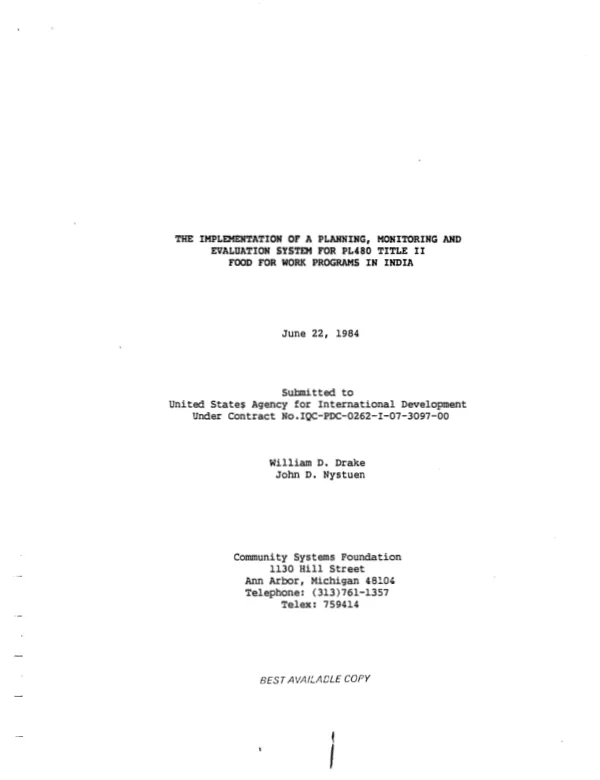
Implementation of a planning, monitoring and evaluation system for PL-480 Title II Food For Work programs in India
Sign inCOMMUNITY SYSTEMS FOUNDATION
Implementation of a planning, monitoring and evaluation system for PL-480 Title II Food For Work programs in India
Evaluates a planning, monitoring, and evaluation system devised for the P.L.
Drake, William D.|Nystuen, John D. · 1984
Sign in to readA free account is required to download.
Abstract
480 Title II program in India. The system was based on: (1) a series of 1983 workshops on system design, and substantial field testing in 1984 of the instruments of protocol derived from these workshops; (2) a 3/84 evaluation which included 11 studies on program impact and recipient profiles; and (3) preliminary system design and field testing by USAID/I, Catholic Relief Services (CRS), and Community Systems Foundation. The present CRS system of monitoring commodities from their arrival at four different port cities to their arrival at consignees' godowns works well. Losses have been minimal both in terms of tonnage and man-days expended, and CRS is using widely accepted management practices in commodity and recipient accounting. There is, however, a general and felt need at all levels of CRS for streamlining the administrative load; while this can be done without changing accepted procedures, it does require giving greater decisionmaking responsibility to lower management personnel. Further, evaluation is being conducted through casual conversation and accounting methods such as periodic reports and reply-by-endorsement, which are not very effective in selecting the best project. Finally, the level of detail required on the current Form 6 (measurements, dimensions, man-days, and capital input by 17 project types) is unrealistic. Consignees must submit an Annual Estimate of Requirements well before there is any firm knowledge of the man-days that will be available or the projects that will be proposed. A key lesson learned is that decentralized decisionmaking is essential in the planning, monitoring, and evaluation phase. The consignee and project holders are in the best position to understand local circumstances and judge a project's potential. Also, CRS' tight management style is ill adapted to the task of evaluating the system. The two management styles should be combined so that decentralized decisionmaking, which characterizes evaluation and planning, and the strictly controlled reporting and response mechanisms used in monitoring stock levels may both be utilized. It is recommended that: (1) the evaluation component be expanded; (2) existing evaluation documents be revised, reports from consignee to zonal office be on a quarterly basis, and the progress/completion report be submitted at the end of each project or semi-annually for continuing projects (the summary statement of progress/completion should be aggregated by project type and reported semi-annually); and (3) the project be fully implemented by 10/84 and CRS assign an individual to coordinate and help implement the system country-wide. (Adapted from ANE Executive Summary, PD-AAT-669, pages 26-27.)
Related documents