USAID DEC
Implementation of a Surgical Safety Toolkit in Bangladesh: Program Learning from Routine Client Tracker Data
Sign inENGENDERHEALTH
Implementation of a Surgical Safety Toolkit in Bangladesh: Program Learning from Routine Client Tracker Data
The Surgical Safety Toolkit (SST) is a set of clinical trackers and quality assurance checklists designed to support the provision of surgical care for fistula and pelvic organ prolapse (POP) at a minimum acceptable standard in low-resource settings.
2020 · 6 pages
Sign in to readA free account is required to download.
Abstract
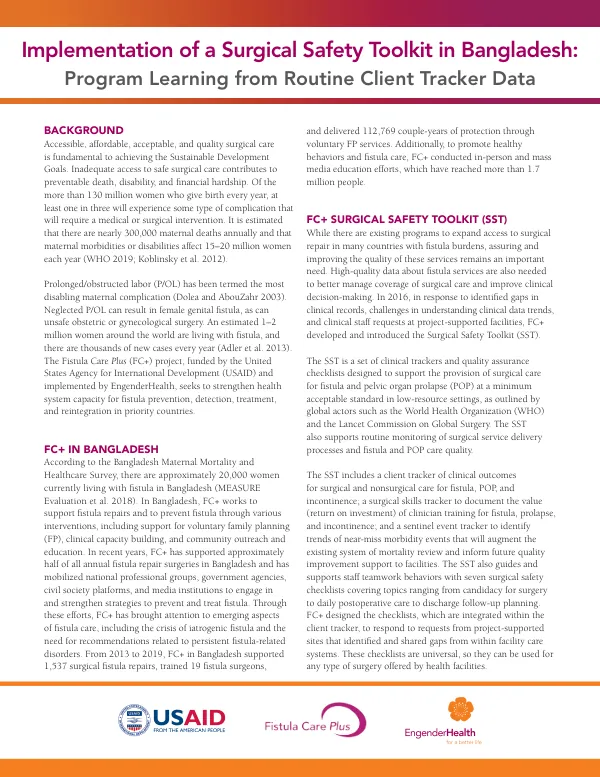
The SST was developed by Fistula Care Plus (FC+) in response to identified gaps in clinical records, challenges in understanding clinical data trends, and clinical staff requests at project-supported facilities. The toolkit includes a client tracker of clinical outcomes for surgical and nonsurgical care for fistula, POP, and incontinence; a surgical skills tracker to document the value (return on investment) of clinician training for fistula, prolapse, and incontinence; and a sentinel event tracker to identify trends of near-miss morbidity events. The SST also guides and supports staff teamwork behaviors with seven surgical safety checklists covering topics ranging from candidacy for surgery to daily postoperative care to discharge follow-up planning. These checklists are universal, so they can be used for any type of surgery offered by health facilities. The SST is designed to support routine monitoring of surgical service delivery processes and fistula and POP care quality. FC+ implemented the SST in seven project-supported fistula repair sites in Bangladesh between April 2017 and June 2019. The implementation teams from participating sites joined an SST launch workshop in March 2017, which emphasized the importance of safe surgery and the role of the SST in improving clinical decision-making. Following the launch, FC+ staff conducted follow-up orientation visits to supported sites to ensure they were comfortable with and had the necessary capacity to begin implementing the SST. The SST components are further described in Table 1. The full SST is available online, and FC+ also partnered with Medical Aid Films to create a video to introduce the SST to providers. The SST has been used to collect information on client care related to fistula, POP, incontinence, and other genital tract conditions. The client tracker is a tool that clinicians can use to collect information on client care, and it is organized into 11 sections. The SST has been implemented in Bangladesh, where FC+ works to support fistula repairs and to prevent fistula through various interventions, including support for voluntary family planning (FP), clinical capacity building, and community outreach and education. In recent years, FC+ has supported approximately half of all annual fistula repair surgeries in Bangladesh and has mobilized national professional groups, government agencies, civil society platforms, and media institutions to engage in and strengthen strategies to prevent and treat fistula. The implementation of the SST in Bangladesh has resulted in improved clinical decision-making and quality of care for fistula and POP patients. The SST has been used to track client outcomes, monitor surgical service delivery processes, and identify trends of near-miss morbidity events. The SST has also been used to provide training and support to clinicians, including surgeons, anesthetists, nurses, and clinical secretaries. The SST has been shown to be effective in improving the quality of care for fistula and POP patients in low-resource settings. The toolkit provides a standardized approach to clinical care, which can help to improve patient outcomes and reduce morbidity and mortality. The SST has the potential to be used in other countries and settings to improve the quality of care for fistula and POP patients. The SST includes a client tracker of clinical outcomes for surgical and nonsurgical care for fistula, POP, and incontinence; a surgical skills tracker to document the value (return on investment) of clinician training for fistula, prolapse, and incontinence; and a sentinel event tracker to identify trends of near-miss morbidity events. The SST also guides and supports staff teamwork behaviors with seven surgical safety checklists covering topics ranging from candidacy for surgery to daily postoperative care to discharge follow-up planning.
Related documents