USAID DEC
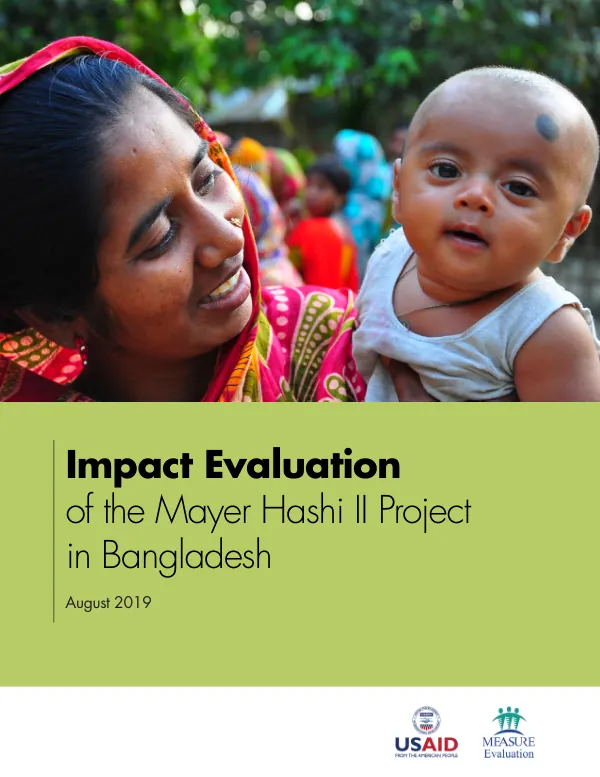
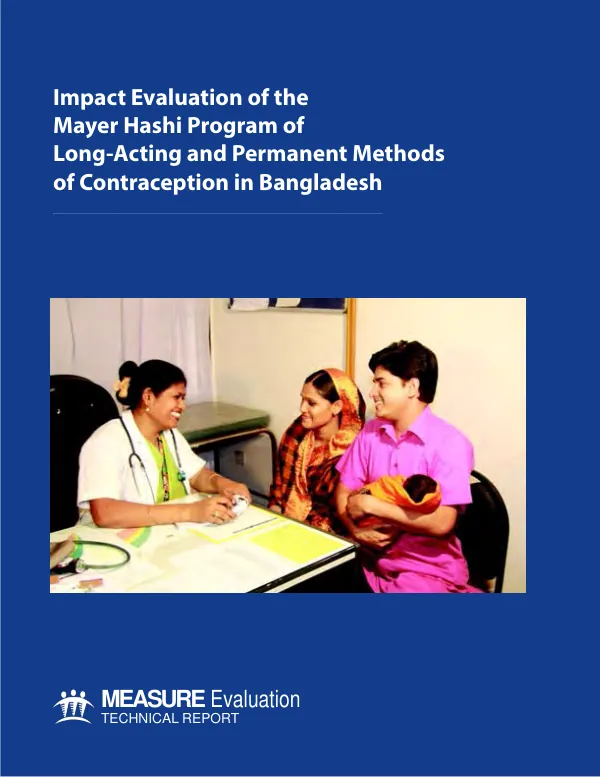
Impact Evaluation of the Mayer Hashi Program of Long-Acting and Permanent Methods of Contraception in Bangladesh
Sign inCAROLINA POPULATION CENTER AT THE UNIVERSITY OF NORTH CAROLINA AT CHAPEL HILL
Impact Evaluation of the Mayer Hashi Program of Long-Acting and Permanent Methods of Contraception in Bangladesh
The Mayer Hashi Program of Long-Acting and Permanent Methods of Contraception in Bangladesh was implemented to increase access to and use of long-acting and permanent methods (LAPM) of contraception among women of reproductive age in Bangladesh.
2014 · 263 pages
Sign in to readA free account is required to download.
Abstract
The program was launched in 2008 and was supported by the United States Agency for International Development (USAID) through the MEASURE Evaluation project. The program's interventions included service provider training, orientation of program managers and community leaders, facilitation of policy changes in the service delivery of LAPM, and intervention implementation and follow-up. The program also provided LAPM services in districts without Mayer Hashi intervention and collaborated with non-governmental organizations (NGOs) to provide LAPM services. The impact evaluation of the Mayer Hashi Program was conducted in 2013-2014 to assess the program's effectiveness in increasing access to and use of LAPM among women of reproductive age in Bangladesh. The evaluation used a conceptual framework that included baseline and endline data collection, surveys of service providers and women, and data analysis. The provider survey found that training coverage was high, with 95% of service providers reporting that they had received training on LAPM. However, the survey also found that provider knowledge, skills, and practices were not always consistent with the training received. The women's survey found that accessibility to LAPM services was high, with 85% of women reporting that they had access to LAPM services. However, the survey also found that the quality of care was not always high, with 20% of women reporting that they had experienced a delay in receiving LAPM services. The evaluation found that the Mayer Hashi Program was effective in increasing access to and use of LAPM among women of reproductive age in Bangladesh. The program's interventions, particularly the service provider training and orientation of program managers and community leaders, were found to be effective in increasing provider knowledge, skills, and practices. The program's collaboration with NGOs was also found to be effective in increasing access to LAPM services in districts without Mayer Hashi intervention. The evaluation also found that the program's impact was greatest in districts where the program's interventions were implemented in combination with other interventions, such as community-based distribution of LAPM. The evaluation also found that the program's impact was greatest among women who had higher levels of education and income. The evaluation recommended that the program's interventions be continued and expanded to reach more women of reproductive age in Bangladesh. The evaluation also recommended that the program's collaboration with NGOs be continued and expanded to increase access to LAPM services in districts without Mayer Hashi intervention. The evaluation also recommended that the program's interventions be tailored to the specific needs of different districts and communities. The Mayer Hashi Program's impact evaluation provides valuable lessons for program implementers and policymakers in Bangladesh and other countries. The evaluation highlights the importance of providing service provider training and orientation of program managers and community leaders in increasing access to and use of LAPM. The evaluation also highlights the importance of collaboration with NGOs in increasing access to LAPM services in districts without Mayer Hashi intervention.