USAID DEC
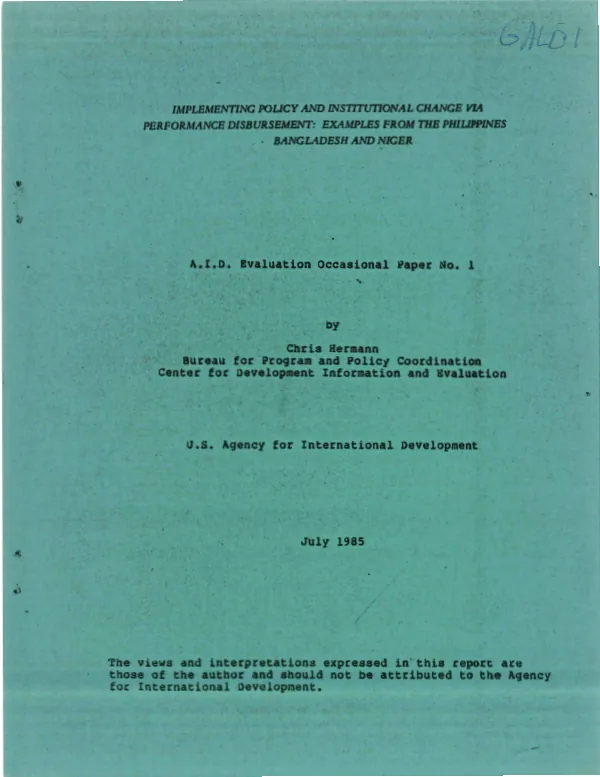
Implementing policy and institutional change via performance disbursement : examples from the Philippines, Bangladesh, and Niger
Sign inUSAID. BUR. FOR PROGRAM AND POLICY COORDINATION. CENTER FOR DEVELOPMENT INFORMATION AND EVALUATION (CDIE)
Implementing policy and institutional change via performance disbursement : examples from the Philippines, Bangladesh, and Niger
Performance disbursement (PD) is a recently developed mechanism whereby A.I.D.
Hermann, Chris · 1985
Sign in to readA free account is required to download.
Abstract
disburses program funds in a series of tranches, each conditioned by host country attainment of pre-established benchmarks in implementing policy and institutional reforms. This paper reviews limited applications of PD in the Philippines, Bangladesh, and Niger in order to evaluate the practice in light of possible wider use. PD's major advantage is that it softens the adverse effects of policy reforms by lengthening the reform process over time and by providing monetary compensation for losses incurred by the reforms. Among other advantages are that it gives A.I.D. greater control over disbursement and promotes mutual agreement on project activity between A.I.D. and the host government. Outstanding issues concerning PD discussed in the report include, inter alia, that: the conditions making PD an appropriate funding mechanism, as well as PD's compatibility with U.S. Government regulations, are unclear; the use of PD is largely a matter of judgment and host country circumstances; PD constitutes for both A.I.D. and the host country a high-risk and staff-intensive activity; and finally, PD does not ensure long-term institutional development. Sixteen guidelines for the further use of PD conclude the study.
Connected topics
Related documents