PARTNERSHIP FOR CHILD HEALTH CARE, INC.
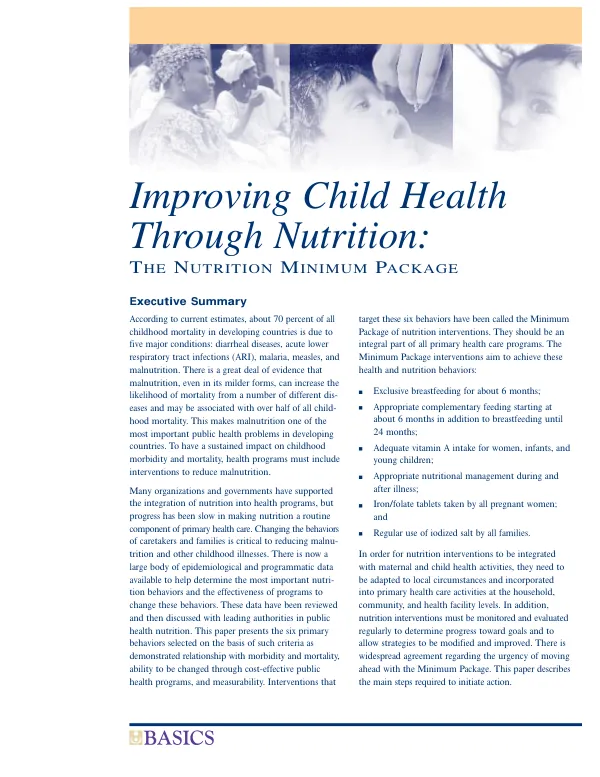
Improving child health through nutrition : the nutrition minimum package
There is a great deal of evidence that even mild malnutrition can increase the likelihood of mortality from disease, and may, in fact, be to blame for over half of all childhood deaths in developing countries.
Sanghvi, Tina G.; Murray, John · 1970
Sign in to readA free account is required to download.
Abstract
Unfortunately, progress has been slow in making nutrition a routine component of primary health care and of caretakers" and families" child care behaviors. This paper presents the six primary caretaker behaviors selected on the basis of such criteria as demonstrated relationship with morbidity and mortality, ability to be changed through cost-effective public health programs, and measurability. These behaviors are: (1) exclusive breastfeeding for about 6 months; (2) appropriate complementary feeding starting at about 6 months in addition to breastfeeding until 24 months; (3) adequate vitamin A intake for women, infants, and young children; (4) appropriate nutritional management during and after illness; (5) iron/folate tablets taken by all pregnant women; and (6) regular use of iodized salt by all families. Interventions that target these six behaviors have been called the Minimum Package of nutrition interventions and should be an integral part of all primary health care programs. In order for nutrition interventions to be integrated with maternal and child health activities, they need to be adapted to local circumstances and incorporated into primary health care activities at the household, community, and health facility levels. They must also be monitored and evaluated regularly to determine progress toward goals and to allow strategies to be modified and improved. There is widespread agreement regarding the urgency of moving ahead with the Minimum Package; the main steps required to initiate action are discussed in conclusion. (Author abstract, modified)
![Nutrition of infants and young children in Zimbabwe : findings from the 1994 Zimbabwe DHS [demographic and health survey] survey](https://covers.devme.ai/gen/73753.webp)