ACADEMY FOR EDUCATIONAL DEVELOPMENT, INC. (AED)
Cost-effectiveness of the nutrition communication project in Mali
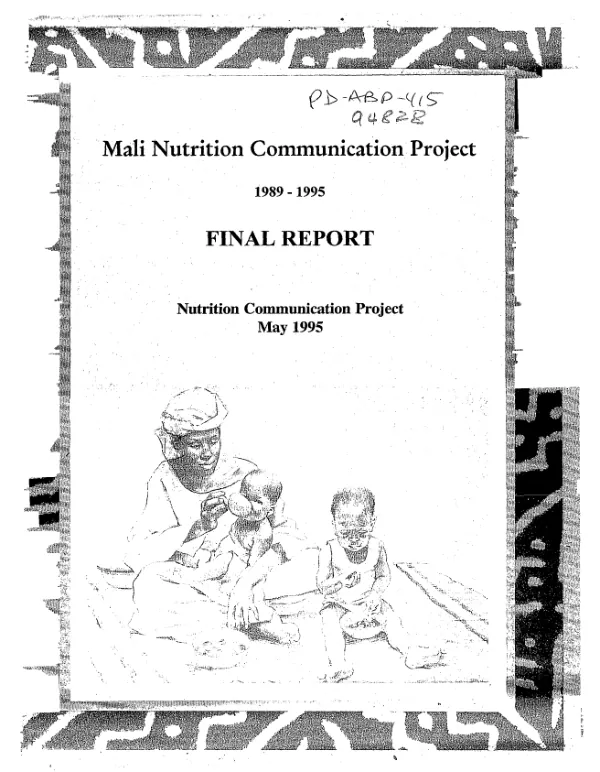
The Nutrition Communication Project (NCP), which was implemented in Mali from 1989 to 1995, addressed malnutrition in children under age 3 through nutrition counseling integrated into existing child survival activities and through complementary communication methods, including radio broadcasts, print media, and village drama.
Ross, Jay · 1997
Sign in to readA free account is required to download.
Abstract
Ten international and domestic PVOs with established community health projects carried out these interventions, with the objective of improving caregivers" nutrition-related behavior. A comparison of baseline (1990) and post-project (1994) surveys in 24 project and 24 control villages indicated reduced prevalence of low weight-for-age and height-for-age among children in the project villages. But at what cost? To obtain cost estimates, the researchers used the funding total provided to the NCP by USAID and UNICEF ($1,094,779). Although this figure does not include inputs provided by PVOs, government agencies, volunteers, or beneficiaries, it does include funds that did not contribute directly to the outcomes measured in the study. The study found that between 1990 and 1994, there was an estimated reduction of 12% in children under age 3 living in project villages in the prevalence of low weight-for-age and of 16% in low height-for-age. Thus, it costs $101 per child saved from underweight and $76 per child saved from stunting. With respect to malnutrition as a direct or indirect cause of death, an estimated 3,822 children"s lives were saved, at a cost of $282 per child. There are reasons to believe that the project"s benefits have been even greater. For example, the analysis does not include the impact on children who were older than 3 at the time of the final evaluation but who had benefited as infants. Nor does it include the impact on children not yet born. To the extent that caregivers change behavior for these younger siblings, benefits can be expected to continue. In addition, many of the materials and methods developed by NCP have been used in similar projects in Niger and Burkina Faso and are being adapted for use elsewhere. These gross estimates of the cost-effectiveness of the Mali intervention ($101 per child removed from malnutrition and $282 per child life saved) compare favorably with others from the literature. Includes references. (Author abstract, modified)
Related documents
Documents in this collection
 2002
2002USAID DEC
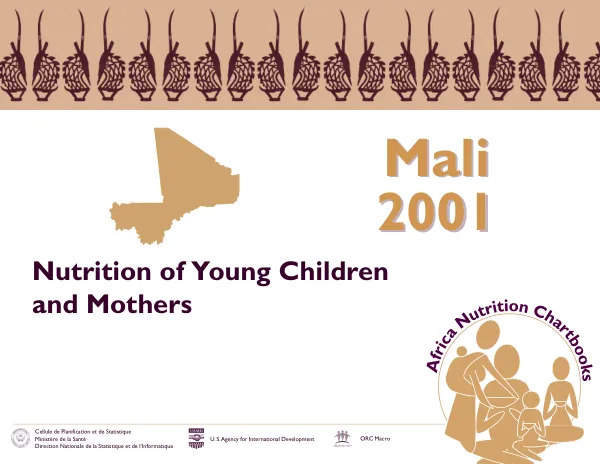
Nurtition of young children and mothers in Mali : findings from the 2001 Mali demographic and health survey = Nutrition des jeunes enfants et des meres au Mali : resultats de l"enquete demographique et de sante au Mali 2001
Open record 1970
1970USAID DEC
![Nutrition of infants and young children in Zimbabwe : findings from the 1994 Zimbabwe DHS [demographic and health survey] survey](https://covers.devme.ai/gen/73753.webp)