USAID DEC
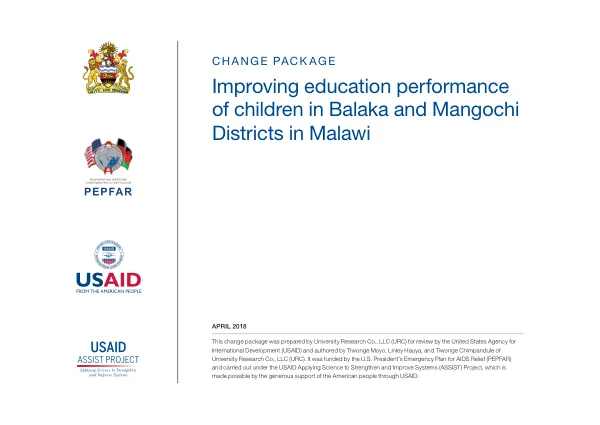
Improving education performance of children in Balaka and Mangochi Districts in Malawi
Sign inENCOMPASS, LLC
Improving education performance of children in Balaka and Mangochi Districts in Malawi
Malawi has an estimated population of 16 million.
2018 · 22 pages
Sign in to readA free account is required to download.
Abstract
The country's HIV prevalence rate is 10.6%, with one million people living with HIV. More than half (58%) of those infected are girls and women. The HIV pandemic continues to infect 10,000 people a year, and approximately 46% of new infections occur among young people aged 15-24 years. The disease impacts thousands of families, leaving a growing number of orphans and vulnerable children (OVC) children affected by HIV and AIDS, now standing at 1.8 million. Almost half (49.6%) of Malawi's girl children are married off before their 18th birthday and 10% of boys and girls aged 6-13 years are not in school. Orphans and vulnerable children and their families in Malawi are faced with a myriad of challenges including access to essential services such as health, education, economic wellbeing, and protection. According to United Nations Educational, Scientific and Cultural Organization's (UNESCO) institute statistics, as of March 2016, 65.75% of the adult population (aged 15 years and above) in Malawi are able to read and write. About 90% of the population still lives below the income poverty line of US$2 per day threshold. The country has a total of 3.6 million pupils enrolled in primary schools, leaving 11% of children of official primary school ages out of school. The country has made strides in improving enrolment nationally in primary schools which is currently at 97% and the completion rate in primary schools is at 74%. However, there remain a number of challenges to attaining good quality education outcomes in the primary schools. The Ministry of Education in their Education Sector Plan (2008-2017) has a strategic priority objective of improving the quality and relevance of education in primary schools. This objective is commendable and achievable if primary schools embrace continuous improvement methods in how they address numerous challenges in existing primary schools. In 2009, the USAID Health Care Improvement (HCI) project, with support from the USAID Mission in Malawi and the U.S. President's Emergency Plan for AIDS Relief (PEPFAR), supported the Ministry of Gender, Children, Disability, and Social Welfare (MOGCDSW) to develop quality standards aimed at guiding the delivery of services provided to vulnerable children in Malawi. The USAID HCI and its follow-on, the USAID Applying Science to Strengthen and Improve Systems (ASSIST) project, had a focused strategy that relied on the following principles: 1) enhancing the capacity of MOGCDSW and the Ministry of Health (MOH) at both the national, district, and community level to facilitate subsequent continuous QI work in various service areas. The use of the QI approach promoted coordination, cost efficiency, and sustainability of quality social services; 2) creating a conducive environment at community level so that care providers were able to identify their own priorities and seek necessary support from various stakeholders providing services; and 3) facilitating further institutionalization of results, service providers focused their efforts in developing processes to align providers and decision makers at all levels in existing service delivery systems. The change package was prepared by University Research Co., LLC (URC) for review by the United States Agency for International Development (USAID) and authored by Tiwonge Moyo, Linley Hauya, and Tiwonge Chimpandule of University Research Co., LLC (URC). It was funded by the U.S. President's Emergency Plan for AIDS Relief (PEPFAR) and carried out under the USAID Applying Science to Strengthen and Improve Systems (ASSIST) Project, which is made possible by the generous support of the American people through USAID. The project aimed to improve education performance of children in Balaka and Mangochi Districts in Malawi. The change package development process involved conducting child assessments, problem analysis, testing changes and collecting data, and implementation of successful tests of change. The project used a multi-sectoral community team approach to identify quality gaps and develop improvement plans to address these gaps using locally available resources and capacities. The team worked tirelessly to identify quality gaps and develop improvement plans to address these gaps. The project also used a model for improvement, which involved creating a conducive environment at community level so that care providers were able to identify their own priorities and seek necessary support from various stakeholders providing services. The project aimed to improve education performance of children in Balaka and Mangochi Districts in Malawi. The project used a change package development process that involved conducting child assessments, problem analysis, testing changes and collecting data, and implementation of successful tests of change. The project also used a multi-sectoral community team approach to identify quality gaps and develop improvement plans to address these gaps using locally available resources and capacities. The project aimed to improve education performance of children in Balaka and Mangochi Districts in Malawi by enhancing the capacity of MOGCDSW and the Ministry of
Related documents