CHEMONICS
Improving Reading, Equity, and Accountability in the DRC – ACCELERE! Activity 1
The ACCELERE!
2016 · 141 pages
Sign in to readA free account is required to download.
Abstract
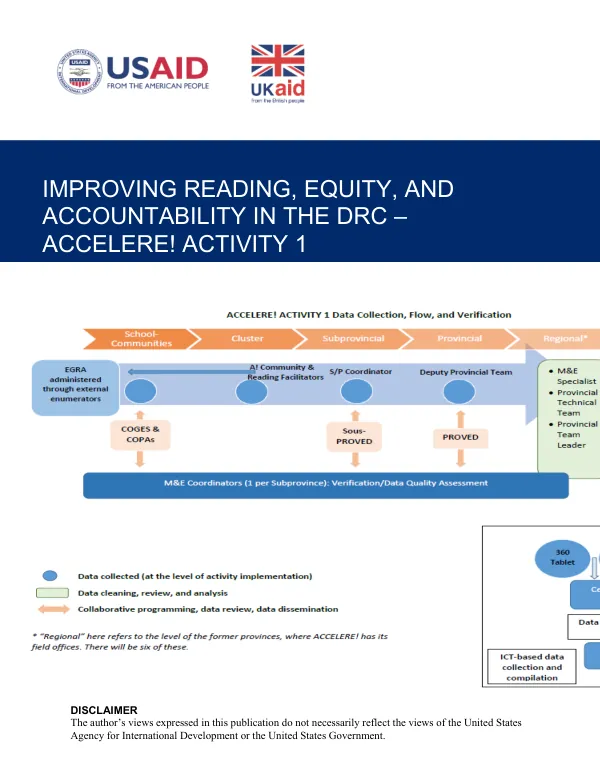
Activity 1, a joint USAID-UKAID project, aims to improve educational outcomes for girls and boys in select sub-provinces within target educational provinces of the Democratic Republic of the Congo (DRC). The project is implemented in collaboration with partners, including Chemonics International, FHI 360, Cambridge Education, School-to-School International (STS), and Caritas Congo. ACCELERE! Activity 1 supports improved learning outcomes in government of the DRC (GDRC) public primary schools, schools supported by religious networks, non-formal schools, and vocational schools. The project's objective is to increase equitable enrollments to a quality education environment, improve education quality, and enhance governance and accountability by stakeholders. To achieve this, ACCELERE! Activity 1 will implement a range of interventions, including farmer training programs, infrastructure development, and market linkage facilitation. The project will also focus on improving reading, equity, and accountability in the DRC, with a particular emphasis on supporting girls and boys to benefit equally from project activities. ACCELERE! Activity 1 will be implemented in 25 education sub-provinces across four target areas, formerly known as Katanga, Kasaï Occidental, Kasaï Oriental, and Equateur. The project will support education service delivery in these areas, with a focus on improving learning outcomes in government of the DRC public primary schools, schools supported by religious networks, non-formal schools, and vocational schools. In addition, the project will work to ensure that all assistance is conflict sensitive and disability inclusive. The project's approach to monitoring, evaluation, learning, and adapting is outlined in the Performance Monitoring and Evaluation Plan (PMEP). The PMEP outlines the key processes and procedures for implementing the plan, including the use of indicators, baselines, and targets. The plan also outlines the data sources and collection methods, as well as the analysis of performance information and reviewing performance. The PMEP is a critical component of the project, as it will enable the project team to track progress, identify areas for improvement, and make adjustments as needed. The project's evaluation, assessment, and operations research plan is also outlined in the PMEP. The plan includes external evaluation, formative assessment, and operations research, which will provide valuable insights into the project's effectiveness and inform future programming. The PMEP also outlines the use of performance indicator reference sheets, which will enable the project team to track progress and identify areas for improvement. Overall, ACCELERE! Activity 1 is a critical component of the USAID/UKAID Projet d'Accés, Lecture, Redevabilité, et Rétention (ACCELERE!) project, which aims to improve educational outcomes for girls and boys in select sub-provinces within target educational provinces of the DRC. The project's focus on improving reading, equity, and accountability, as well as its emphasis on supporting girls and boys to benefit equally from project activities, make it a critical component of the project.
Related documents