USAID DEC
Improving the Quality of Preservice Education for Health Service Providers in Nigeria
Sign inJOHNS HOPKINS UNIVERSITY
Improving the Quality of Preservice Education for Health Service Providers in Nigeria
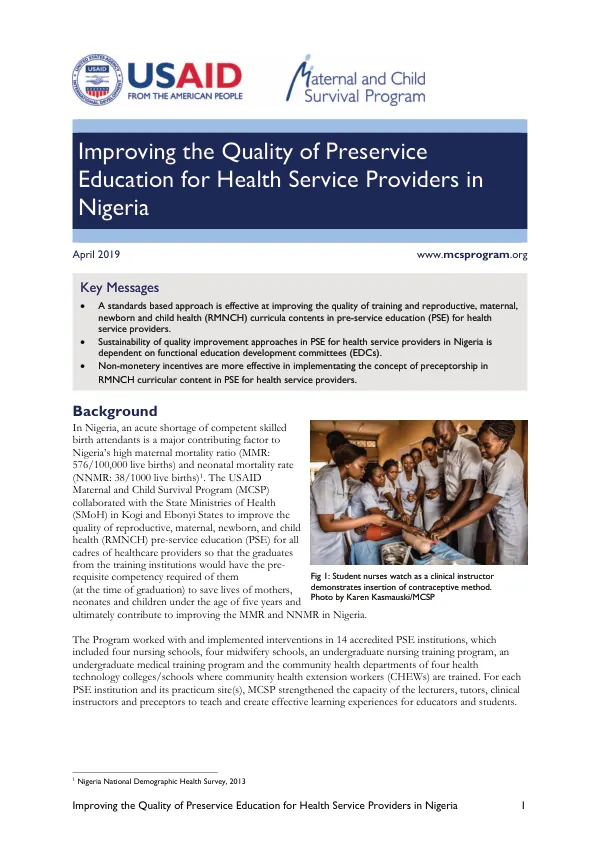
The USAID Maternal and Child Survival Program (MCSP) collaborated with the State Ministries of Health (SMOH) in Kogi and Ebonyi States to improve the quality of reproductive, maternal, newborn, and child health (RMNCH) pre-service education (PSE) for all cadres of healthcare providers.
2019 · 6 pages
Sign in to readA free account is required to download.
Abstract
The program aimed to equip graduates from training institutions with the prerequisite competency required to save lives of mothers, neonates, and children under the age of five years, ultimately contributing to improving the maternal mortality ratio (MMR) and neonatal mortality rate (NNMR) in Nigeria. The program worked with 14 accredited PSE institutions, including four nursing schools, four midwifery schools, an undergraduate nursing training program, an undergraduate medical training program, and the community health departments of four health technology colleges/schools. For each PSE institution and its practicum site, MCSP strengthened the capacity of lecturers, tutors, clinical instructors, and preceptors to teach and create effective learning experiences for educators and students. A standards-based approach was effective in improving the quality of training and RMNCH curricula contents in PSE for health service providers. Sustainability of quality improvement approaches in PSE for health service providers in Nigeria was dependent on functional education development committees (EDCs). Non-monetary incentives were more effective in implementing the concept of preceptorship in RMNCH curricular content in PSE for health service providers. MCSP supported the institutions to set up EDCs at the State level, which held meetings on a quarterly basis to deliberate on issues relating to quality improvement in the training institutions. The head of each institution was provided with necessary guidance and support to form EDCs at the institutional level. The EDCs held monthly meetings to discuss issues relating to quality improvement in the training of health workers at the school level. A baseline assessment of each institution was conducted in November 2016 by MCSP in conjunction with members of the State level EDC using the 69 RMNCH performance standards across four thematic areas. The assessment showed that 15 (21.7%) of the 69 performance standards were not met by any of the 14 training institutions. The reasons for the identified gaps included poor classroom and clinical simulation training skills of the tutors, lecturers, and clinical instructors, lack of or poorly equipped clinical simulation laboratories, lack of a library or insufficient quantities of appropriate reference training materials, and lack of functional management committees or infrequent meetings of the committees. The data from the baseline assessment was used as a guide to develop a roadmap to improve the quality of training in these institutions through a standards-based approach. Each of the identified gaps was addressed by developing an appropriate intervention. MCSP worked directly with the individual PSE institution to implement the following interventions to bridge the identified gaps over a period of 14 months: capacity building for faculty members, setting up clinical skills simulation laboratories, installation of audio-visual teaching aids, and quarterly supportive supervision. The results of the endline assessment (post-intervention) showed significant improvements in the quality of training in the institutions. The mean score for all 14 institutions increased from 24 to 74.5, indicating a substantial improvement in the quality of training. The data also showed that the number of institutions meeting the performance standards increased from 0 to 12, indicating a significant improvement in the quality of training. The results of the endline assessment suggest that the interventions implemented by MCSP were effective in improving the quality of training in the institutions.
Related documents