USAID DEC
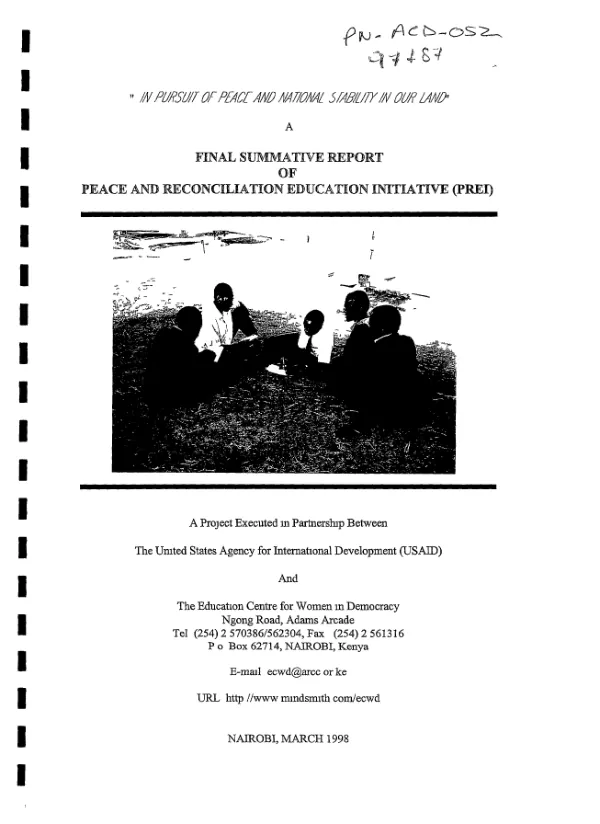
In pursuit of peace and national stability in our land : a final summative report of peace and reconciliation education initiative (PREI)
Sign inEDUCATION CENTRE FOR WOMEN IN DEMOCRACY
In pursuit of peace and national stability in our land : a final summative report of peace and reconciliation education initiative (PREI)
Records activities and results of the Peace and Reconciliation Education Initiative (PREI), aimed at engendering peace in parts of Kenya"s North-Rift Valley which had been rocked by inter-ethnic violence between 1991 and 1995.
1998
Sign in to readA free account is required to download.
Abstract
The program, which targeted the aggressors, was implemented by the Education Centre for Women in Democracy over a 17-month period beginning August 1996. Program activities included, but were not limited to: an orientation seminar for members of the Peace Task Force (PTF); induction fora for the youth who helped execute the ethnic cleansing; seminars for elders and the clergy; women"s informal village fora; development of public awareness materials, including a peace song; and researching and documenting cultural covenanting processes among the Kalenjin ethnic groups. The project reached 7,254 persons (women, men, and youth) directly and 299,130 indirectly. Program objectives were more than adequately met, as demonstrated by target beneficiaries" willingness to report sensitive details regarding the planning and execution of the ethnic cleansing. Voluntary statements have also been recorded from beneficiaries who testified before a privileged tribunal set up to investigate and try perpetrators of the violence. In the three areas where the program was operational, inter-ethnic local peace committees were established and staved off potentially explosive situations. Attempts were made to ignite violence in the project sites, particularly Uasin Gishu and Molo, but local residents did not participate, and the ensuing violence did not escalate, although some deaths occurred. Signs of normalcy in these areas include the reopening of multi-ethnic primary and secondary schools. In addition, various ethnic groups interact freely at market centers, and commodity exchanges between them is fast approaching levels of the pre-ethnic violence period. The core lesson learned was that human beings are inter-dependent, and that the disruption of this linkage leads to suffering for both the aggressor and the victim. It was also learned that peace building need not be restricted to technical skills transfer on conflict prevention, management, and resolution. The program succeeded by imparting information on human rights and democracy, thereby helping program beneficiaries appreciate the symbiotic nature of human existence. This realization manifested itself in the phrase "You are because I am, and I am because you are." The program model was shared at a regional conference in Kigali, Rwanda and was subsequently recommended for the 1998 Best Practices Awards of Excellence in Improving the Living Environment. Specific recommendations to move forward include the hosting of a National Stability and Peace Conference. (Author abstract, modified)
Related documents