USAID. MISSION TO BELIZE
Increased productivity through better health
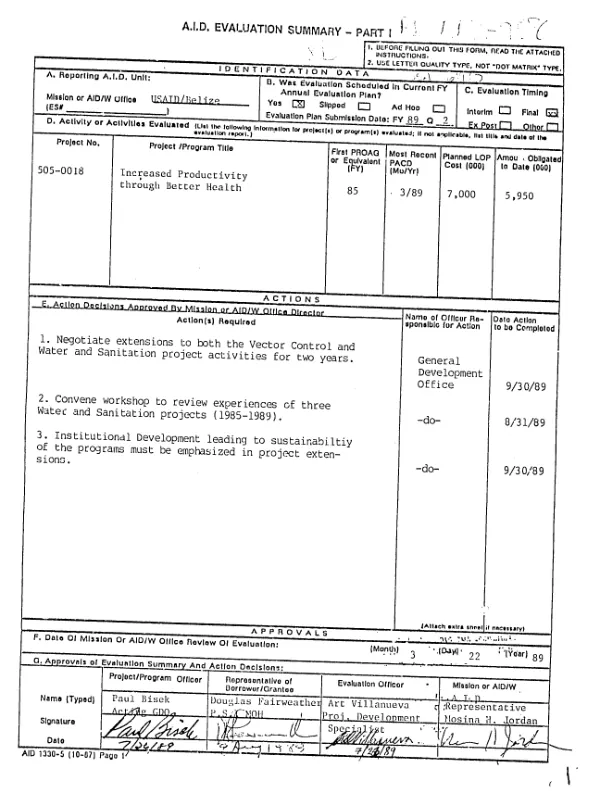
Summarizes final evaluation (XD-AAZ-958-A) of a project in Belize to reduce the incidence of dengue fever and malaria and extend rural coverage of potable water and adequate sanitation.
1989
Sign in to readA free account is required to download.
Abstract
The evaluation covered the period FY85-1/89. Both the vector control and the water supply and sanitation (WS&S) components experienced host country funding shortages, personnel problems, and insufficient community participation. While malaria targets were achieved in all but two districts, the country faces a continuing problem due to the importation of malaria by immigrants from neighboring countries. The malaria component also shows many signs of remaining a vertical eradication program with few attempts to integrate it with general health services. Aedes aegypti eradication goals were changed in 1988 to emphasize urban areas where dengue is more likely to occur, but reduction of urban infestation has not yet been reached. Although this component has a better than average control unit, it suffers from being a temporary organization with high personnel attrition rates. Technical training made a significant contribution toward developing a sustainable vector control program, but training in community involvement was weak and community participation activities are yet to be initiated. WS&S targets were unrealistic and not met. The component suffers from the lack of a well-defined community participation activity, frequent personnel turnover, difficulties in staffing key counterpart positions, and a less than candid relationship with counterparts. Training of district health educators and coordinators as well as of community leaders has been poor, due to the nonexistence or inadequacy of budget support. As a result, there is concern that the village health committees will stop functioning. It is recommended that the component be refocused to emphasize community participation, training, and institution building, rather than physical targets (i.e., wells drilled, hand pumps installed, and latrines built). The following lessons were noted: (1) full-time counterpart staff for the long-term advisors must be assigned from the beginning of technology transfer and institutional development is to occur; (2) advisors should work in the same office, and side by side with their counterparts to build trusting relationships; (3) the preponderance of temporary workers in and the vertical nature of the vector control program are not conducive to development of a sustainable program. An action decision extends both project components for 2 years.
Related documents
![Technical assistance [evaluation] report : village level water and sanitation (VLWS) project](https://covers.devme.ai/gen/22495.webp)
![Technical assistance [evaluation] report : village level water and sanitation (VLWS) project](https://covers.devme.ai/gen/8348.webp)