MASSACHUSETTS INSTITUTE OF TECHNOLOGY. CENTER FOR POLICY ALTERNATIVES
Industrial and urban development
Industry accounts for only about six percent of the Sahel-Sudan"s GNP.
McPherson, R. N. · 1970
Sign in to readA free account is required to download.
Abstract
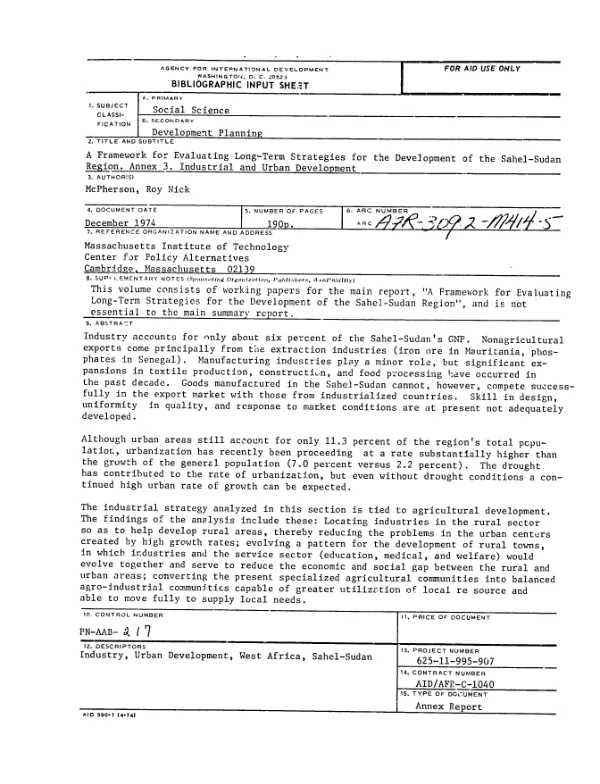
Nonagricultural exports come principally from the extraction industries (iron ore in Mauritania, phosphates in Senegal). Manufacturing industries play a minor role, but significant expansions in textile production, construction, and food processing have occurred in the past decade. Goods manufactured in the Sahel-Sudan cannot, however, compete successfully in the export market with those from industrialized countries. Skill in design, uniformity in quality, and response to market conditions are at present not adequately developed. Although urban areas still account for only 11.3 percent of the region"s total population, urbanization has recently been proceeding at a rate substantially higher than the growth of the general population (7.0 percent versus 2.2 percent). The drought has contributed to the rate of urbanization, but even without drought conditions a continued high urban rate of growth can be expected. The industrial strategy analyzed in this section is tied to agricultural development. The findings of the analysis include these: Locating industries in the rural sector so as to help develop rural areas, thereby reducing the problems in the urban centers created by high growth rates; evolving a pattern for the development of rural towns, in which industries and the service sector (education, medical, and welfare) would evolve together and serve to reduce the economic and social gap between the rural and urban areas; converting the present specialized agricultural communities into balanced agro-industrial communities capable of greater utilization of local resources and able to move fully to supply local needs.
Related documents