USAID DEC
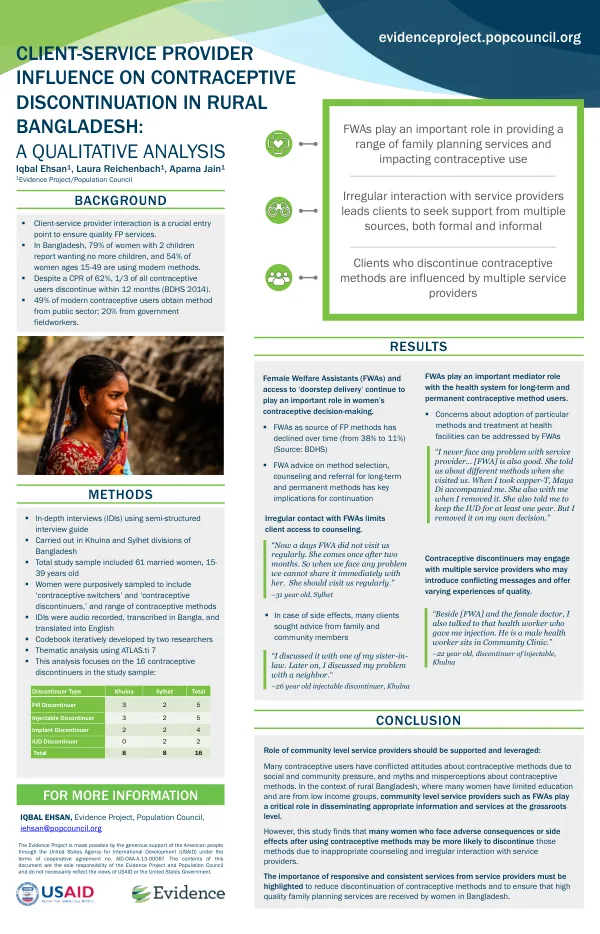
Influence on Contraceptive Discontinuation in Rural Bangladesh: A Qualitative Analysis
Sign inPOPULATION COUNCIL
Influence on Contraceptive Discontinuation in Rural Bangladesh: A Qualitative Analysis
In rural Bangladesh, the role of community-level service providers, particularly Female Welfare Assistants (FWAs), is crucial in disseminating family planning information and services.
1 pages
Sign in to readA free account is required to download.
Abstract
FWAs play a significant mediator role between the health system and long-term and permanent contraceptive method users. Despite their importance, FWAs' advice on method selection, counseling, and referral for long-term and permanent methods has declined over time, from 38% to 11% (Source: BDHS). The study found that many women who face adverse consequences or side effects after using contraceptive methods may be more likely to discontinue those methods due to inappropriate counseling and irregular interaction with service providers. In the context of rural Bangladesh, where many women have limited education and are from low-income groups, FWAs are essential in providing high-quality family planning services. However, the study reveals that FWAs' irregular contact with clients limits their access to counseling, leading to conflicting messages and varying experiences of quality. In-depth interviews with 16 contraceptive discontinuers in Khulna and Sylhet divisions of Bangladesh highlighted the importance of responsive and consistent services from service providers. The study found that clients who discontinue contraceptive methods are influenced by multiple service providers, and irregular interaction with service providers leads clients to seek support from multiple sources, both formal and informal. The study emphasizes the need to support and leverage the role of community-level service providers, such as FWAs, to reduce discontinuation of contraceptive methods and ensure high-quality family planning services are received by women in Bangladesh. The study's findings suggest that FWAs' doorstep delivery and access to family planning methods continue to play an important role in women's contraceptive decision-making. However, the study also highlights the need for FWAs to provide more responsive and consistent services to clients, particularly in addressing concerns about adoption of particular methods and treatment at health facilities. The study's results have significant implications for the development of family planning programs in rural Bangladesh, emphasizing the importance of strengthening the role of community-level service providers in providing high-quality family planning services.