MINISTRY OF PUBLIC HEALTH
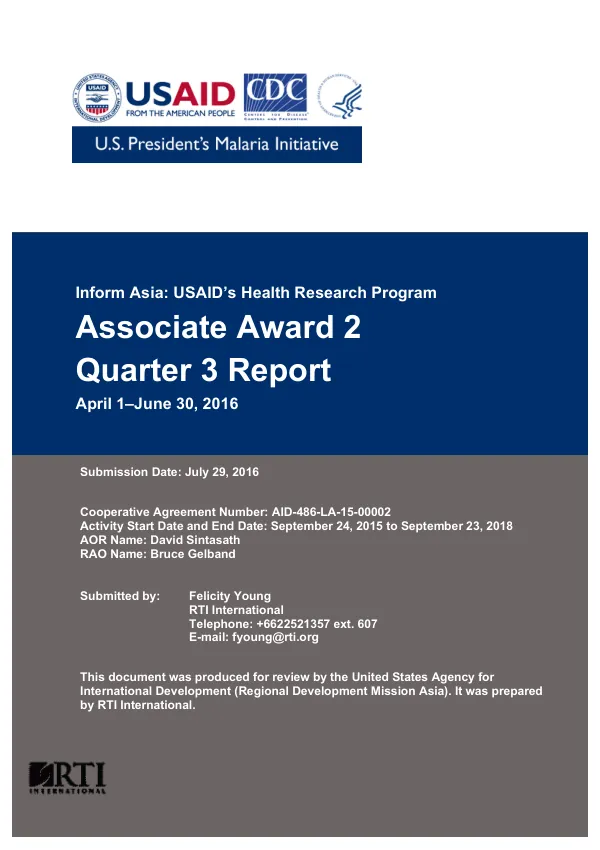
Inform Asia: USAID’s Health Research Program Associate Award 2
The Inform Asia: USAID's Health Research Program Associate Award 2 is a cooperative agreement between the US Agency for International Development (USAID) and RTI International.
2016 · 17 pages
Sign in to readA free account is required to download.
Abstract
The program aims to provide high-quality technical assistance in malaria surveillance and generate, use, and document strategic information and evidence for advocacy for the National Malaria Control Programs (NMCPs) in Thailand and Lao People's Democratic Republic (PDR). The goal of the program is to support both countries in their quest to achieve malaria elimination, with Thailand aiming to be malaria-free by 2024 and Lao PDR by 2030. The program's revised work plan, submitted on June 30, 2016, outlines three objectives and six key activities. Objective 1 focuses on strengthening malaria surveillance systems in Thailand and Lao PDR, with activities including increasing collaborative partnerships, conducting a work plan consultation of malaria surveillance systems, and secondment of national consultants to support malaria surveillance activities and build local capacities. Objective 2 aims to support national programs to evaluate elimination models and strategies for implementation and scale-up, with activities including conducting a cost-benefit analysis of malaria elimination and providing technical assistance to the NMCP in data quality, completeness, timely reporting, analysis of data, and information use. The program's geographic coverage includes Thailand and Lao PDR, with a reporting period of Quarter 3, April 1-June 30, 2016. The program's prime implementing partner is RTI International, with a contract/agreement number of Associate Cooperative Agreement No. AIDd486dLAd15d00002. The program's period of performance is from September 24, 2015, to September 23, 2018. The program's progress narrative highlights the implementation of activities, including the secondment of national consultants to support malaria surveillance activities and build local capacities in Thailand and Lao PDR. The program has also conducted a work plan consultation of malaria surveillance systems in both countries. Additionally, the program has provided technical assistance to the NMCP in data quality, completeness, timely reporting, analysis of data, and information use. The program's achievements include the completion of the work plan consultation of malaria surveillance systems in both countries and the secondment of national consultants to support malaria surveillance activities and build local capacities. The program has also made progress in providing technical assistance to the NMCP in data quality, completeness, timely reporting, analysis of data, and information use. The program's implementation status highlights the challenges faced, including the need for increased collaboration among stakeholders and the need for improved data quality and completeness. The program's management and administrative issues are also discussed, including the need for improved communication and coordination among team members. The program's planned activities for the next quarter include the implementation of the revised work plan, the completion of the cost-benefit analysis of malaria elimination, and the provision of technical assistance to the NMCP in data quality, completeness, timely reporting, analysis of data, and information use. The program also plans to conduct a work plan consultation of malaria surveillance systems in both countries and to second national consultants to support malaria surveillance activities and build local capacities. The program's main findings and recommendations from the work plan consultation of malaria surveillance systems in both countries highlight the need for improved data quality and completeness, the need for increased collaboration among stakeholders, and the need for improved communication and coordination among team members. The program's action points include the development of a plan to improve data quality and completeness, the establishment of a stakeholder committee to improve collaboration, and the implementation of a communication and coordination plan among team members. The program's financial report for the quarter ending June 30, 2016, highlights the expenditures and income of the program during the reporting period. The report includes a summary of the program's financial status, including the total expenditures and income, and a breakdown of the expenditures by category.
Related documents