USAID DEC
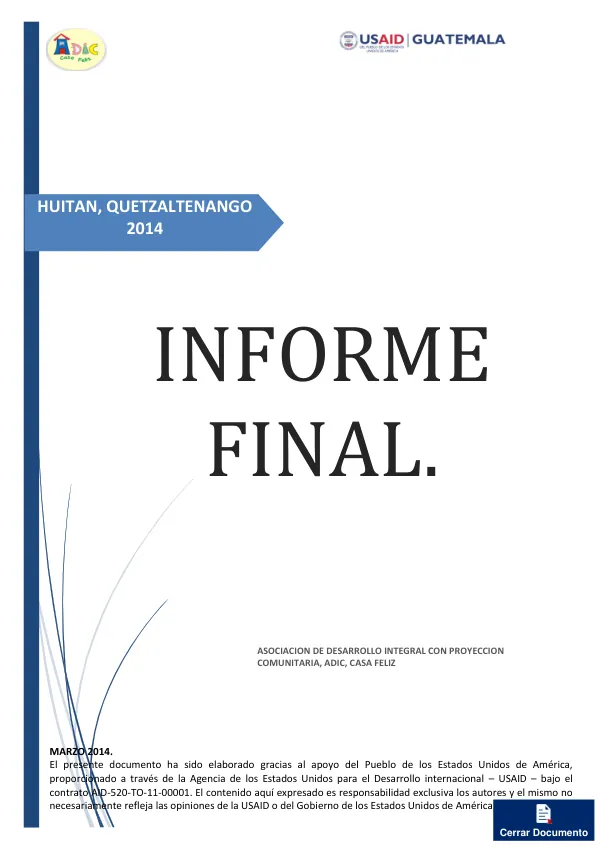
Informe Final: Experiencia Piloto de Incidencia para Mejorar la Prestación de los Servicios de Salud, Educación, Nutrición, Agua, Saneamiento y Agricultura a nivel comunitario como parte de la Estrategia de Incidencia de INCOPAS
Sign inUSAID DEC
Informe Final: Experiencia Piloto de Incidencia para Mejorar la Prestación de los Servicios de Salud, Educación, Nutrición, Agua, Saneamiento y Agricultura a nivel comunitario como parte de la Estrategia de Incidencia de INCOPAS
The Experiencia Piloto de Incidencia for Improving the Provision of Health, Education, Nutrition, Water, Sanitation, and Agriculture Services at the Community Level was a project implemented in the western region of Guatemala, specifically in the departments of San Marcos and Quetzaltenango.
2014 · 35 pages
Sign in to readA free account is required to download.
Abstract
The project was carried out by Asociación de Desarrollo Integral con Proyección Comunitaria, ADIC, Casa Feliz, with the support of the United States Agency for International Development, USAID, under the contract AID-520-TO-11-00001. The project aimed to strengthen the capacity of local and municipal organizations of indigenous women to advocate for improved health, education, nutrition, agriculture, water, and sanitation services, with a focus on cultural relevance and quality. The project also sought to enhance the capacity of INCOPAS to influence policy decisions on priority issues. The project's objectives were achieved through several specific activities. Firstly, the project aimed to strengthen community organization and vigilance in the provision of health, education, nutrition, agriculture, water, and sanitation services. This was achieved by fortifying the organizational structure of communities, the figure of community development councils, and the integration of community authorities, including auxiliary mayors. Secondly, the project sought to sensitize and capacitate civil society on access, quality, and cultural relevance of health, education, nutrition, agriculture, water, and sanitation services. This was done through a process of sensitization and training, which included the development of a training plan covering topics such as health, education, nutrition, agriculture, water, and sanitation. Thirdly, the project aimed to improve agricultural productivity by investigating and implementing programs promoted by the state. This involved visiting rural extension offices, training producer groups on the implementation of gardens and nurseries, and coordinating with the Ministry of Agriculture to provide follow-up support to the groups. Fourthly, the project sought to review and reproduce materials on obtaining safe drinking water. This involved collecting information and developing a tri-fold brochure on safe drinking water, which was printed and distributed to community members to raise awareness about the importance of boiling or chlorinating water to prevent diseases. Lastly, the project aimed to develop sensitization processes on the use of latrines and solid waste management. This involved conducting sensitization talks in communities to educate people on the proper use of latrines and the importance of proper waste management to prevent diseases. The project achieved significant results, including the strengthening of community organization and vigilance, the sensitization and capacitation of civil society, the improvement of agricultural productivity, and the development of sensitization processes on safe drinking water and waste management. The project was implemented in 13 communities, with a total of 16 communities initially planned. The project's success was hindered by the refusal of the community of Alonzo de San Juan Ostuncalco to participate, citing the project's focus on education and capacity building as a low priority. Additionally, the project's presence in Concepción Chiquirichapa coincided with the establishment of a municipal coordinator, which led to a decision not to work at the municipal level to avoid conflict with other institutions. The project's achievements were recognized through the development of dialogues with decision-makers at the municipal, departmental, and national levels, including mayors, deputies, governors, ministers, and secretaries of state. The project's success was also reflected in the improvement of health, education, nutrition, agriculture, water, and sanitation services in the target communities.
Related documents