USAID DEC
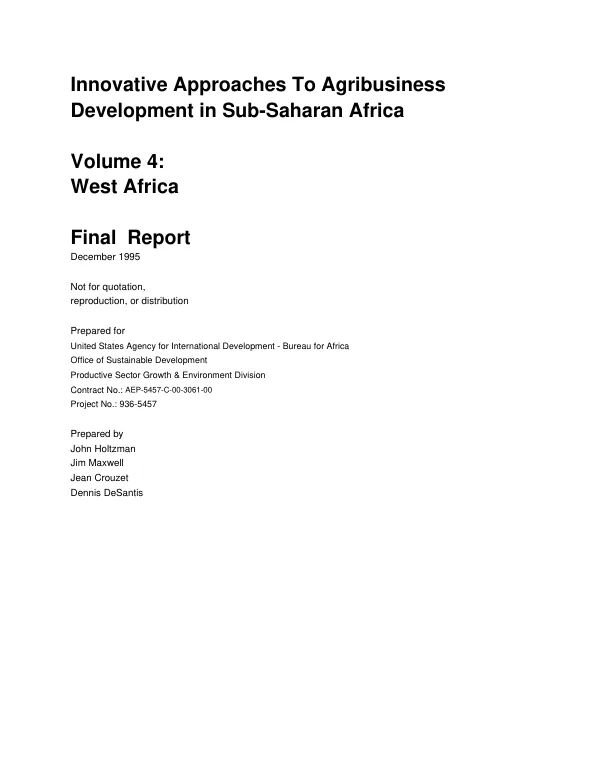
Innovative approaches to agribusiness development in sub-Saharan Africa. Volume 3. East Africa
Sign inUSAID. BUR. FOR AFRICA. OFC. OF SUSTAINABLE DEVELOPMENT
Innovative approaches to agribusiness development in sub-Saharan Africa. Volume 3. East Africa
This report synthesizes lessons learned from donor agencies" innovative agribusiness projects in the East African countries of Kenya and Uganda.
Maxwell, Jim; Abbott, Richard D. · 1997
Sign in to readA free account is required to download.
Abstract
The lessons, which are intended to help USAID design and implement its own agribusiness projects in the region, focus on nontraditional agricultural exports (NTAE), NTAE associations, small- and medium-scale enterprises (SMEs), financial services to agribusiness, and monitoring and evaluation (M&E) of agribusiness projects. Key findings are follows. (1) USAID can maximize the impact of its scarce resources by focusing NTAE projects on a few high-potential, medium-sized firms participating in high-potential product lines, as determined by subsector market opportunity assessments. TA provided to exporters should strike a balance between high-value (e.g., pre-pack horticultural products) and lower-value (e.g., cleaned and graded pulses) items in order to mitigate risk and maximize export earnings. (2) Business association development projects need guidelines for assessing an association"s potential for success and monitoring its progress in meeting member needs. The projects should include management training and provide beneficiary associations with matching grants for association development activities in order to stimulate member involvement and commitment. (3) Key constraints to SME development are lack of marketing expertise and minimal knowledge of sources of financial assistance (especially working capital) and how to apply for them. (4) Key constraints to agribusiness lending by financial institutions are the shortage of commercially viable projects and poor loan and investment "packaging" by the borrower, not lack of funds. (5) USAID M&E is in the early stages of development, but is more advanced than that of other donors. Substantial opportunity exists for enhancing USAID monitoring of direct and indirect impact by project component and type beneficiary, and through cost-benefit analysis. Both general and country-specific recommendations are included. Appendices contain detailed project assessments, association and private enterprise profiles, and a bibliography.
Related documents