USAID DEC
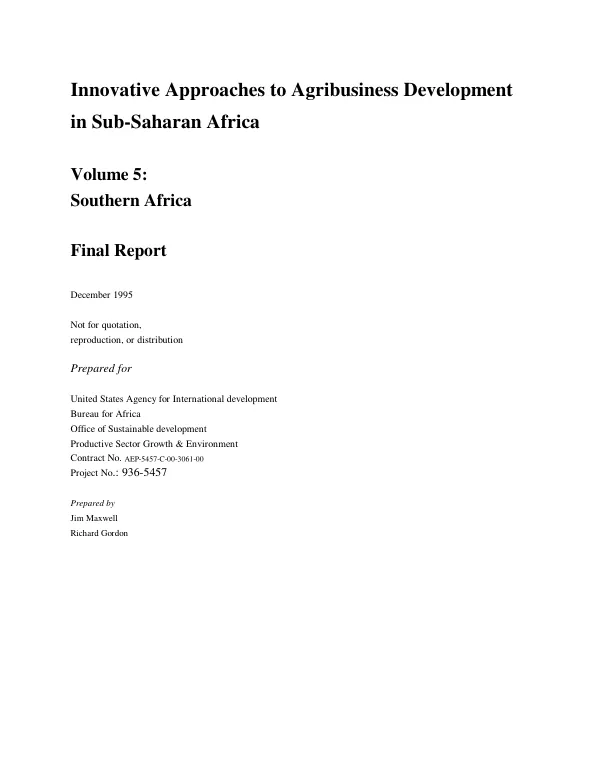
Innovative approaches to agribusiness development in sub-Saharan Africa -- volume 5 : Southern Africa -- final report
Sign inABT ASSOCIATES, INC.
Innovative approaches to agribusiness development in sub-Saharan Africa -- volume 5 : Southern Africa -- final report
This report on donor agencies" innovative agribusiness projects in the southern African countries of Zimbabwe, Mozambique, and Tanzania focuses on nontraditional agricultural exports (NTAE) development, association development, small and medium enterprise (SME) development, and financial services to agribusiness, with emphasis on SMEs and NTAEs.
Maxwell, Jim; Gordon, Richard · 1995
Sign in to readA free account is required to download.
Abstract
The study finds that there is significant potential for development of NTAEs in the three countries and that under the right conditions, smallholders and SMEs could participate in NTAE development. Development of NTAEs is constrained by a lack of entrepreneurial equity/collateral, inadequate infrastructure (especially roads, airports, and communications), and poor organization (i.e., the lack of a clear understanding of the highest priority opportunities [products and markets] and the optimal strategies and structures for capitalizing on these opportunities). Also, there has been very little direct donor interest and support for NTAEs in the three countries, although programs are under consideration in Zimbabwe and Mozambique. Because agriculture accounts for a very large proportion of employment and GDP in all three countries, there is a strong need to develop agribusiness SMEs. The key constraints facing indigenous SMEs are a shortage of management skills, particularly in marketing and cost control, and lack of equity/collateral, especially in rural areas where valuation is difficult and there are land tenure problems. There are quite a few donor programs for supporting commercial SMEs, but none offers the full range of services required by a fledgling indigenous SME. As a result, the impact of these programs on agribusiness, employment, and the geographic areas with the greatest need, is minimal. There are PVO-supported rural microenterprise programs, but these represent more social than economic development, although some PVOs (e.g., CARE) are beginning to develop commercial indigenous SMEs. The report also discusses the potential/need, constraints, and current level of donor support for agribusiness association development and for providing financial services to agribusiness. Elements that donors should stress in all four types of programs are detailed, with special attention to program monitoring and evaluation. An appendix contains detailed profiles of projects, associations, financial organizations, and private agribusinesses in each country. General recommendations are as follows. (1) An ongoing, formal, and sub-Saharan Africa-wide information exchange should be established on agribusiness development lessons learned and the implications for USAID project/activity design and implementation. (2) Multidonor agribusiness development projects (especially if financing focused) should be explored, especially where cooperatives are responsible for an area where they have extensive experience. Also, some PVOs (e.g., CARE in Zimbabwe and Mozambique) may be able to move beyond production agriculture and social development into economic development, and should therefore be considered as partners for agribusiness development projects, especially in rural areas. (3) Agribusiness development projects must be managed by individuals with considerable successful commercial agribusiness experience. Local staffing should take place from the highest positions downward so that as much local input as possible can be incorporated into the staffing process. All expatriate positions must have a local counterpart. (4) Country-level agribusiness opportunities that USAID should assist in supporting are an integrated services horticulture development center focused on indigenous SMEs in Zimbabwe, a cashew and coconut rehabilitation project focused on the role of SMEs in Mozambique, and an integrated services, NTAE-focused Food and Agribusiness development Center located in the Arusha/Moshi area in Tanzania.
Related documents
Documents in this collection
 1996
1996USAID DEC
Constraints analysis and interventions for stimulating indigenous agribusiness development in Southern Africa : volume one -- primary research, final report
Open record 1997
1997USAID DEC