USAID. MISSION TO INDIA
Institutional analysis for empowerment of women in environmental decision making
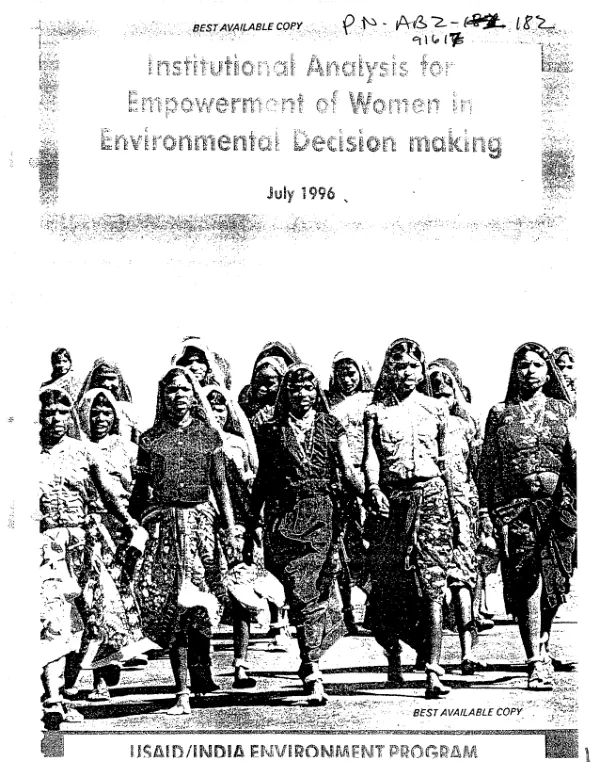
Strategies for strengthening women"s role in environmental decisionmaking are highlighted in this review of successful efforts undertaken in this field by NGOs, donors, and government departments in India.
1996
Sign in to readA free account is required to download.
Abstract
Chapter 3, the heart of the report, profiles 22 successful NGOs/projects on the basis of certain success criteria, such as ability to meet clients" immediate needs, employ participatory approaches, enlist women as local mobilizers, organize training for women, etc. The NGOs/projects are categorized into four types: large well-established entities; those focusing on women"s environmental problems; those working on the environment, with special focus on women as well; and those with networking and support capacities for area/regional problems. Each profile describes the organization"s philosophy, objectives, approach, geographical coverage, environment activities, women"s participation, achievements (quantitative and qualitative), and factors aiding and inhibiting expansion; address and contact information is also provided. Chapter 4 reviews government and donor support for women in environment activities and profiles 18 donors, looking at their geographical coverage, issue focus, project areas/types, and in some cases funding level. A summary of donor support is presented as a ready reference. Chapter 5 presents lessons learned in the categories of women"s capacity building and organizational capacity, along with recommendations for USAID. An annex provides the addresses for 69 NGOs/projects (including those profiled in chapter 3) and 18 donors. Includes bibliography.