USAID DEC
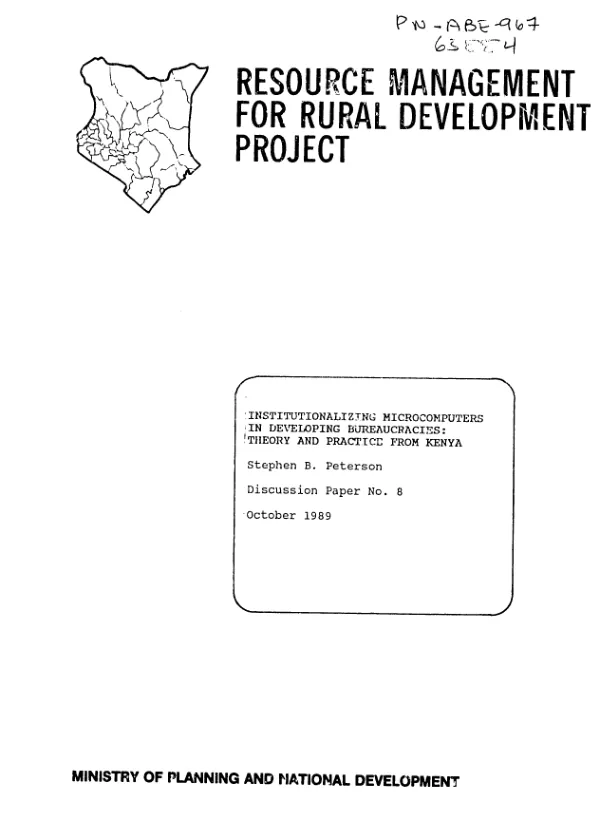
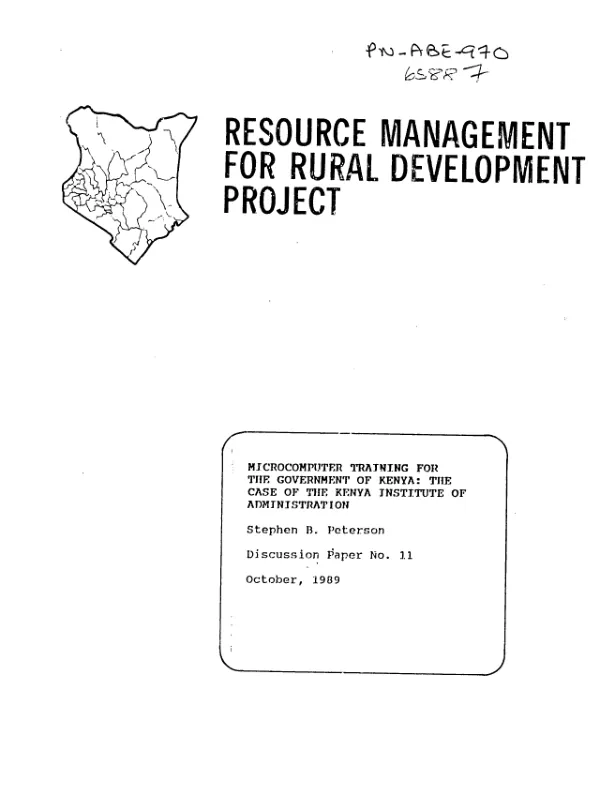
Institutionalizing microcomputers in developing bureaucracies : theory and practice from Kenya
Sign inKENYA. MINISTRY OF PLANNING AND NATIONAL DEVELOPMENT
Institutionalizing microcomputers in developing bureaucracies : theory and practice from Kenya
The significance of a computer application is more important than its simplicity in institutionalizing the application in a developing country"s bureaucracy.
Peterson, Stephen B. · 1989
Sign in to readA free account is required to download.
Abstract
Such is the thesis of this report, which is tested here using a three part framework to measure the significance of an application, the complexity of an application, and the administrative capacity required to support the technology. Computer applications can be significant for policy, administration, or both, and ranked accordingly. The complexity of an application depends on its configuration (enduser vs. systems) and its role (automate vs. informate). Combining the categories of role and configuration defines the strategy of use, which includes four types: enduser/automate, enduser/informate, system/automate, and system/informate. The third part of the framework, administrative capacity, has four components: policy, leadership, internal administration, and bureaucratic hygiene. This framework is then used to analyze computer applications in the Government of Kenya which represent the four strategies of computer use to determine the relative institutionalization of the technology. The study finds that the complexity of an application affects the degree of administrative capacity required to institutionalize the application. It concludes that critical applications, even if they are complex, are more likely to be institutionalized than simple applications which are not critical. (Author abstract)
Connected topics
Related documents
![Report : NAREPP [natural resources and environmental policy project] management information system [Sri Lanka]](https://covers.devme.ai/gen/55668.webp)